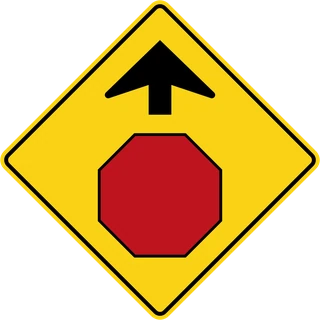
Stop sign ahead
Warns that a stop sign is coming up but may be hidden, for example by a curve or hill. Begin slowing now so you can stop completely at the sign.
Remember: Little red octagon inside a yellow diamond: the stop is around the corner.
75 signs
Warns that a stop sign is coming up but may be hidden, for example by a curve or hill. Begin slowing now so you can stop completely at the sign.
Remember: Little red octagon inside a yellow diamond: the stop is around the corner.
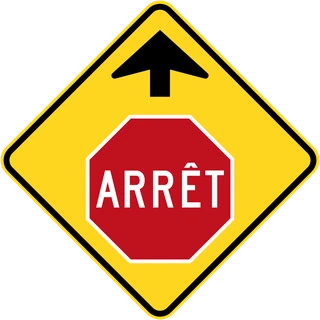
Only in Québec
Québec version of the stop-ahead warning, showing the ARRÊT octagon. A stop sign follows shortly; slow down so you can stop fully.
Remember: Yellow diamond with ARRÊT — prepare to stop.
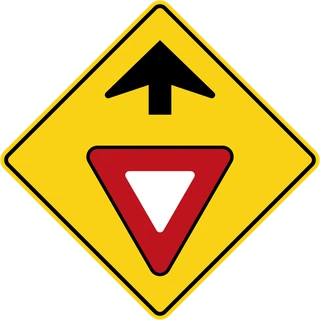
A yield sign is ahead. Slow down and be ready to give way to traffic on the road you are approaching.
Remember: Small red-bordered triangle in a diamond: the yield is coming.
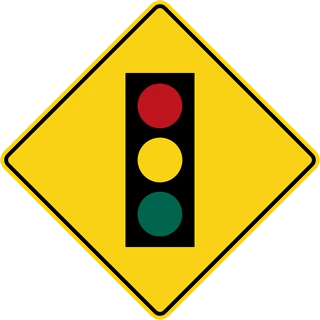
Traffic lights are ahead, often where they are hard to see in time. Slow down and be prepared to stop if the light is red or about to change.
Remember: Three dots in a diamond = a traffic light you cannot see yet.
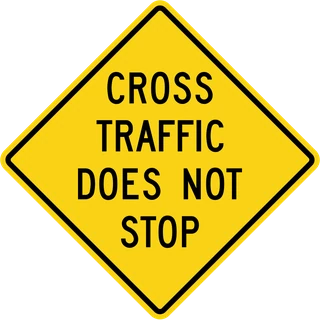
Posted at stop signs where only your road stops. Traffic on the crossing road will not stop for you, so wait for a safe gap before entering.
Remember: Your stop is not their stop.
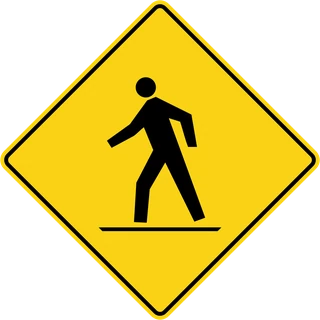
A pedestrian crossing is ahead. Slow down and scan both sidewalks.
Remember: Yellow diamond walker: crossing coming.
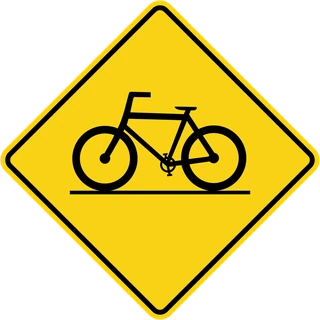
A bike path or trail crosses the road ahead. Watch for cyclists, who may be moving fast.
Remember: Bike in a diamond: look both ways for riders.
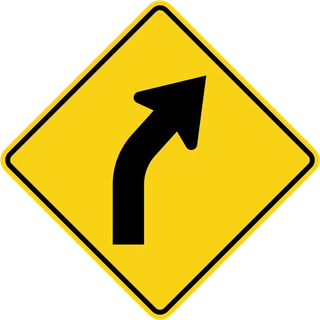
The road curves to the right ahead. Slow down before the curve, not in it; an advisory speed plate may be attached.
Remember: Gentle bend in the arrow = gentle curve.
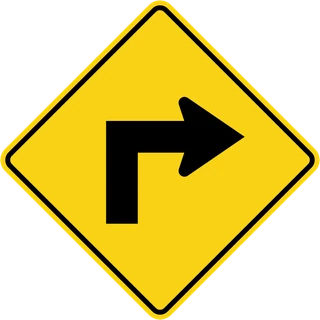
A sharp (near 90°) turn ahead. Reduce speed significantly.
Remember: Right-angle arrow = right-angle road.
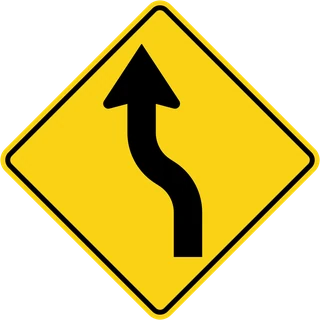
Two curves in opposite directions, first to the left. Keep a steady speed and stay in your lane through both.
Remember: S-shaped arrow: left then right.
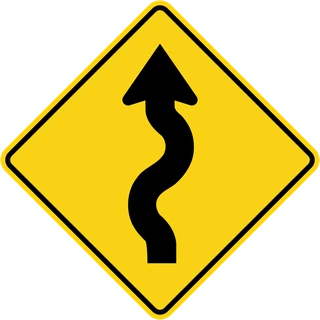
A series of three or more curves ahead. Slow down and stay alert over the whole section.
Remember: Squiggly arrow = many bends.
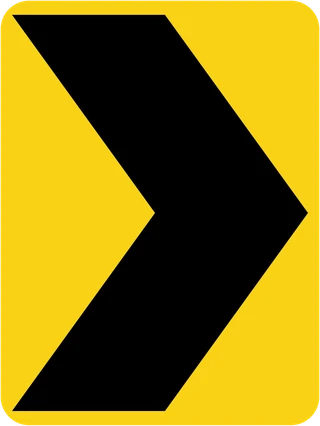
Black-on-yellow chevrons placed along the outside of a sharp curve to show its direction. The more chevrons, the sharper the curve.
Remember: Follow the arrowheads around the bend.
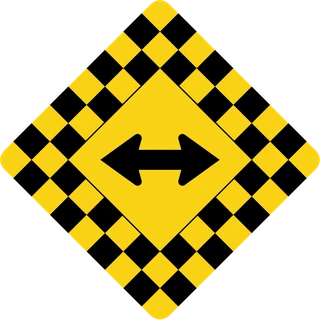
Yellow-and-black checkerboard marks a dangerous end of road or abrupt change, such as a T-intersection at the end of a straight. Slow down; you must turn.
Remember: Checkerboard = danger, the road does not continue.
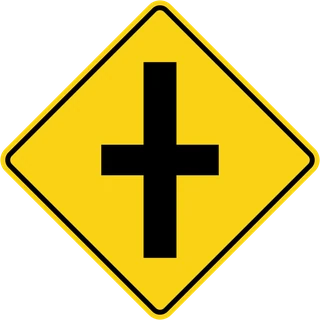
A crossroad is ahead. Watch for vehicles entering from both sides and for turning traffic.
Remember: Cross in a diamond: four ways to meet trouble.
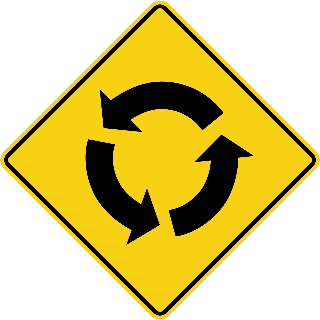
A roundabout is ahead. Slow down, yield to traffic already circulating, travel counter-clockwise and signal right before your exit.
Remember: Circular arrows: yield on entry, counter-clockwise inside.
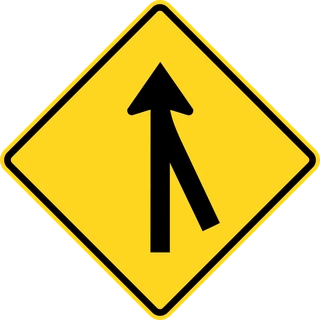
Two roads, or a ramp and a road, join ahead and traffic from the right will merge into your lane. Adjust your speed or change lanes if safe to make room; drivers on both roads share responsibility for a smooth, safe merge (Ontario: equally responsible).
Remember: Two roads become one: both sides make it smooth.
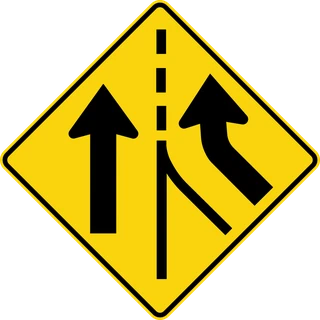
A lane is added from the right; entering traffic gets its own lane and does not have to merge.
Remember: Parallel arrows: no merge needed.
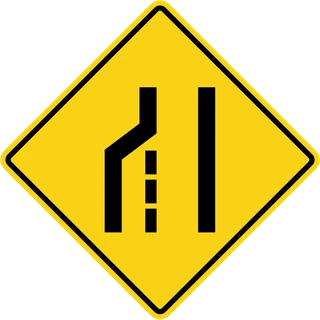
The left lane ends ahead; traffic in it must merge right. Through drivers should leave space.
Remember: Dashed line stops: that lane is finishing.
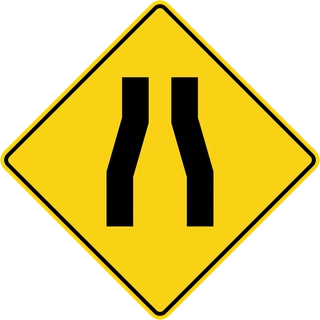
The pavement becomes narrower ahead on both sides. Slow down and keep to your lane.
Remember: Two lines pinching in.
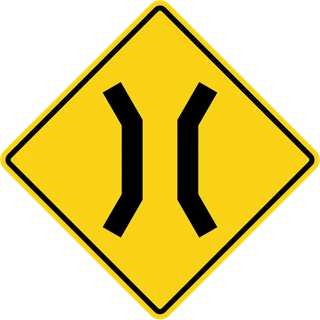
The bridge ahead is narrower than the road. Slow down; on very narrow bridges one direction may have to yield.
Remember: Lines curve inward at a bridge.
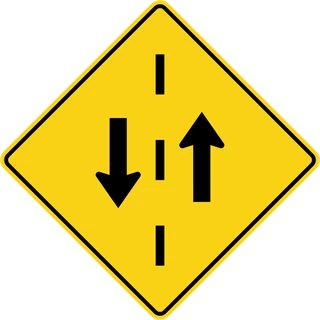
A one-way or divided road becomes two-way. Keep right and expect oncoming vehicles.
Remember: Up and down arrows on yellow: oncoming traffic starts.
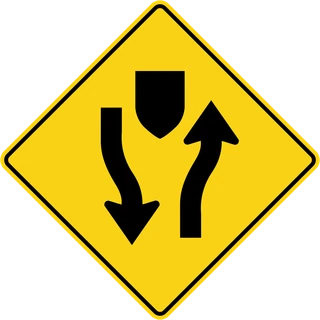
The road splits around a median ahead. Keep right of the divider.
Remember: Arrows split around the island.
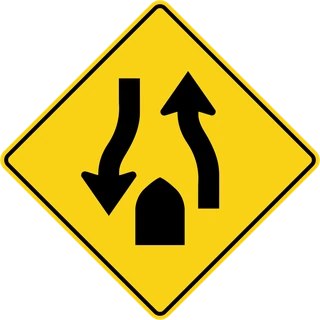
The median ends and the road becomes two-way again. Keep right and watch for oncoming traffic.
Remember: Arrows rejoin: back to sharing.
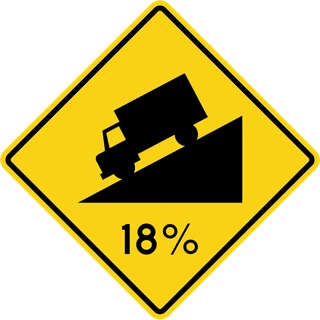
A steep downgrade ahead (the percentage may be shown). Shift to a lower gear before descending and avoid riding the brakes.
Remember: Truck on a slope: gear down before you go down.
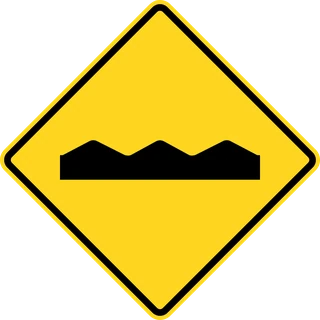
A bump or uneven pavement ahead. Slow down to keep control and protect your vehicle.
Remember: Jagged line: brace for the jolt.
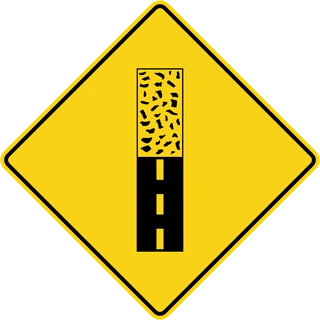
The paved surface ends and gravel begins. Slow down; braking and steering grip are reduced on gravel.
Remember: Pavement turning to dots = gravel.
The shoulder is soft gravel or earth and may give way. Avoid driving on it; if you drop a wheel off, ease off the gas and steer gently back.
Remember: Soft = don't trust the edge.
The street ahead has no outlet. Posted at the entrance so you can avoid entering.
Remember: No exit = you'll be coming back this way.
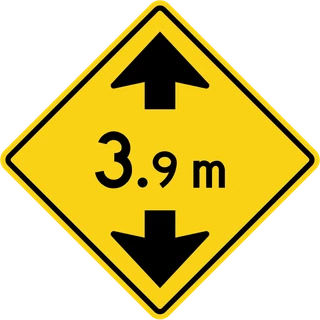
A bridge or structure ahead has limited clearance; the height shown is the maximum that will fit. Mainly for trucks, buses and RVs.
Remember: Arrows pointing at the number: that's your ceiling.
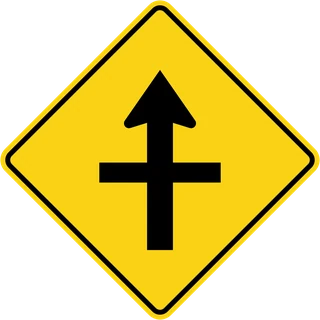
An intersection is ahead where the crossing road (shown as the thicker line) has the right-of-way. Slow down and be ready to yield or stop; you may be facing a stop or yield sign.
Remember: Thick line wins: the heavier road has the right-of-way.
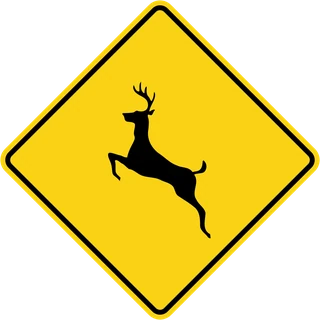
Deer frequently cross here, most often at dusk and dawn. Slow down, scan the ditches, and brake firmly in a straight line rather than swerving.
Remember: One deer means more deer.
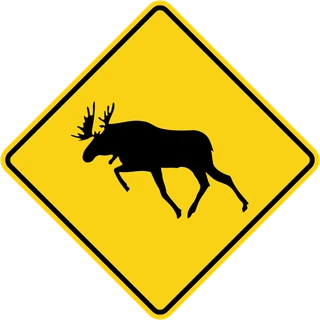
Moose are common on this stretch. They are tall and dark, hard to see at night, and a collision can crush the roof; reduce speed especially after dark.
Remember: Moose: aim for the hindquarters only if a hit is unavoidable, never swerve into oncoming traffic.
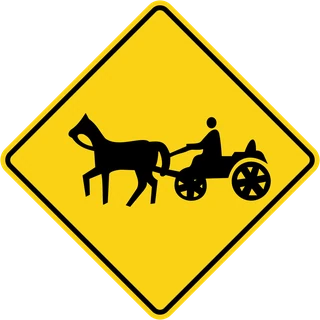
Buggies and carts share this road (Amish and Mennonite areas in Ontario and Manitoba). They move slowly; pass only when safe and give horses room.
Remember: Buggy ahead: patience, wide pass, no horn.
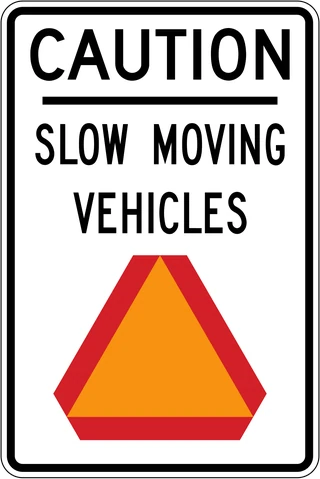
Farm machinery and other slow vehicles (40 km/h or less) use this road. They carry the orange-and-red slow-moving-vehicle triangle on the back.
Remember: Orange triangle on the back = 40 km/h or less.
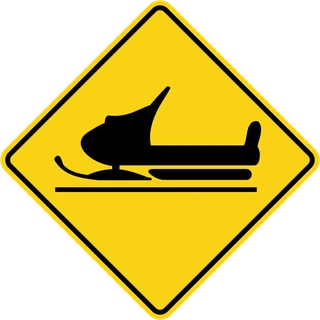
Snowmobiles cross the road here in winter. Watch for them, especially at night and in blowing snow.
Remember: Snowmobile in a diamond: winter crossing.
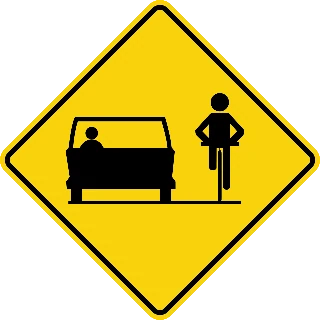
Cyclists use this road and drivers share it with them. Slow down, pass a cyclist only when it is safe and with plenty of room, and watch for bikes near the right edge of the lane.
Remember: Car and bike side by side: the lane is shared.
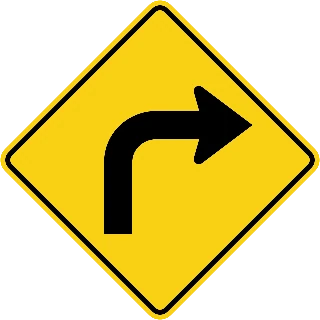
The road ahead bends sharply to the right. Slow down before the curve, to any advisory speed shown on a tab below the sign, and keep to your lane.
Remember: A bent arrow, not a right angle: a sharp curve, not a square turn.
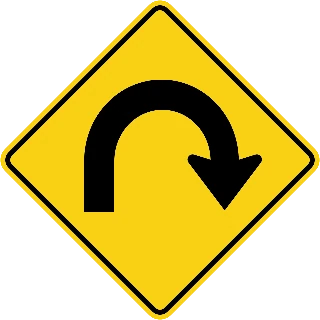
The road doubles back on itself in a very tight curve to the right. Slow down well before it, stay in your lane and expect oncoming vehicles to cut close.
Remember: An arrow that turns back on itself: a hairpin.
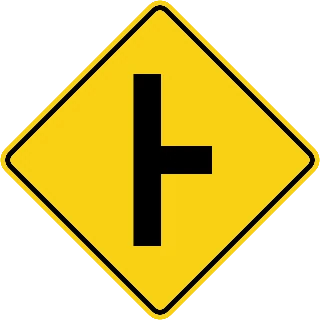
A side road joins from the right ahead. Watch for vehicles entering your road or slowing to turn into the side road.
Remember: The short stub shows where the side road joins.
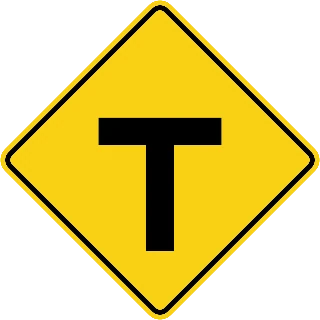
The road you are on ends at a crossroad ahead. You will have to turn left or right, so slow down and be ready to stop or yield.
Remember: A T: your road ends at the top bar.
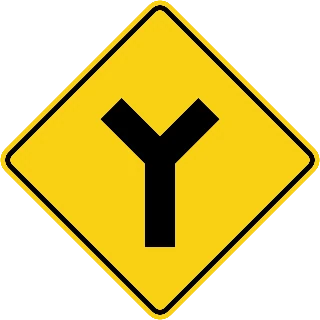
The road splits into two branches ahead. Choose your branch early, slow down and watch for traffic using the other branch.
Remember: A Y: the road forks in two.
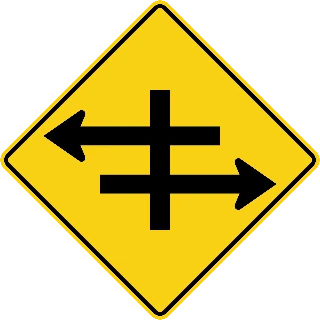
The road ahead crosses a divided highway, so you will cross two roadways separated by a median. Check traffic on each roadway before you cross it.
Remember: Two crossing bars with arrows both ways: a divided road to cross.
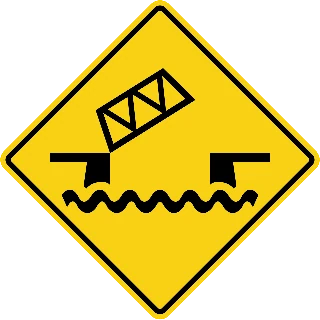
A lift or swing bridge ahead can open to let boats through. Be ready to stop when signals flash or gates come down, and never drive around the gates.
Remember: A bridge span tilting over water: it can open.
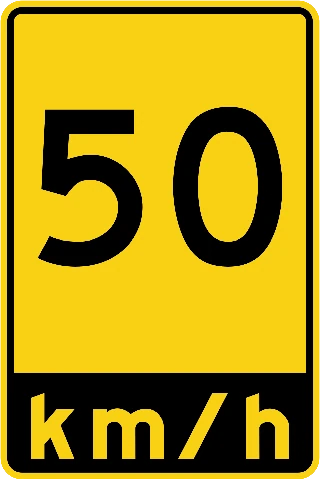
The recommended speed for the exit or entrance ramp ahead in good conditions. It is advice, not a legal limit, but slow to it or below, and lower still in rain, snow or ice.
Remember: Yellow means advice: black on yellow is never the legal maximum.
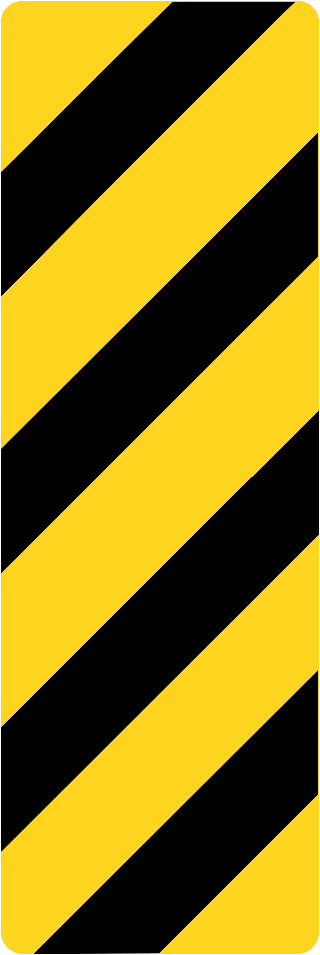
Black and yellow stripes mark an obstruction at or near the edge of the road, such as a bridge pier, an abutment or the end of a guide rail. Keep clear of it.
Remember: Striped panel = something solid right beside your path.
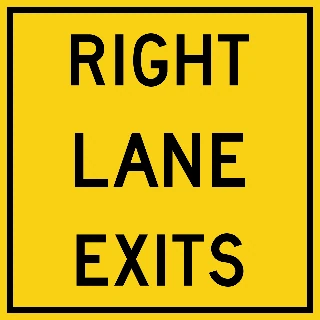
The right lane leads only to the exit ahead and does not continue. If you are staying on the road, move left early; if you are leaving, stay in it.
Remember: Exit-only lane: in it, you leave.
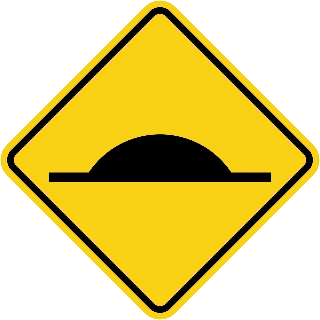
A raised hump across the road ahead is there to slow traffic. Slow down before it to keep control and avoid damage.
Remember: One rounded hump across the road.
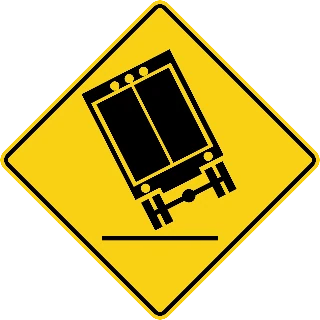
Trucks and other tall vehicles can tip over on the curve or ramp ahead if they take it too fast. Truck drivers must slow down; other drivers should give trucks room.
Remember: A tilting truck: tall vehicles slow down here.
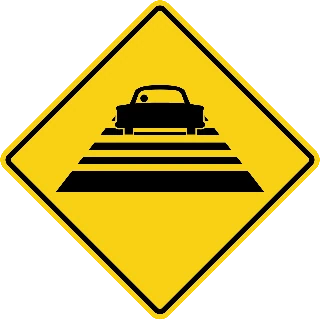
Raised or grooved strips across the road ahead make noise and vibration to get your attention, often before a stop or another hazard. Slow down and be ready for what follows.
Remember: Car on a row of bars: you will feel them before you see the hazard.
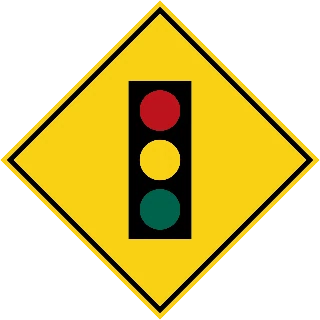
Traffic signals are ahead, often hidden by a curve or hill. When this sign carries a PREPARE TO STOP WHEN FLASHING tab and its amber beacons flash, the light ahead is red or about to turn red: slow down and be ready to stop.
Remember: Flashing beacons on the sign = red light ahead.
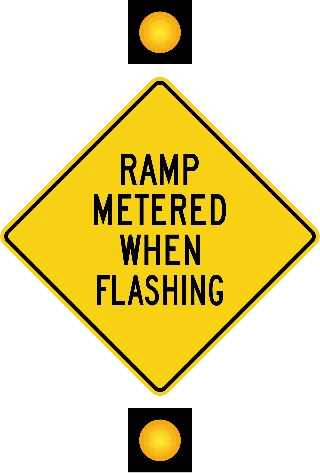
Only in Ontario
When the amber lights flash, a ramp-metering signal on the entrance ramp ahead lets vehicles onto the freeway one at a time. Stop at the line on red and go on green, one vehicle per green.
Remember: Metered: one car per green.
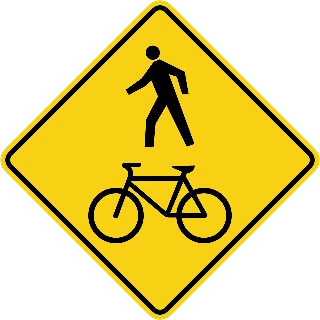
A path used by pedestrians and cyclists crosses the road ahead, often a trail. Slow down and be ready to yield to people crossing.
Remember: Walker above, bike below: a trail crossing for both.
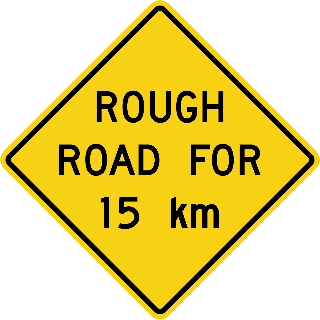
The road surface is rough or broken for the distance shown. Slow down, keep a firm grip on the wheel and leave more space.
Remember: Words and a distance: how long the bad surface lasts.
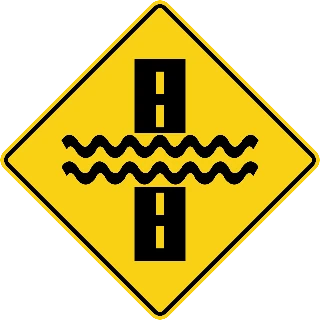
The road ahead may be covered by water (a ford, a low spot or seasonal flooding). Never drive into moving water or water of unknown depth; turn around and use another route.
Remember: Waves across the road: turn around, don't drown.
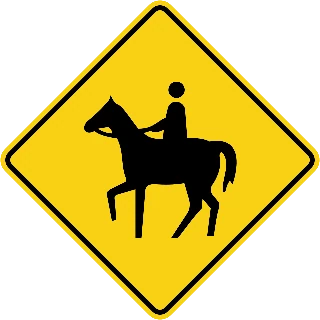
People on horseback may be on or beside the road. Slow down, pass slowly and wide, and do not sound your horn or rev your engine, which can frighten horses.
Remember: A rider on a horse: quiet and slow.
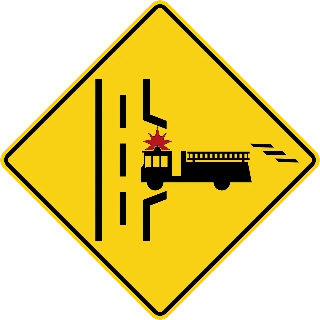
Fire trucks may suddenly enter the road from a fire station on the right. Keep the entrance clear, watch for flashing lights and yield to emergency vehicles.
Remember: Fire truck with a red light leaving the side: a fire station driveway.
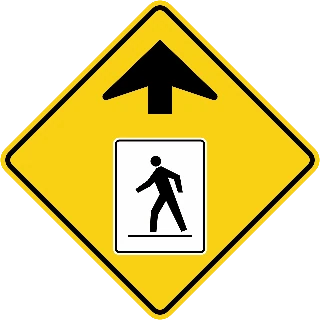
Only in Ontario
An Ontario pedestrian crossover is ahead. Slow down, watch for pedestrians and be ready to stop and wait until the person has completely crossed the road. Passing is not allowed within 30 m of the crossover.
Remember: Arrow plus the crossover symbol: it is just ahead.
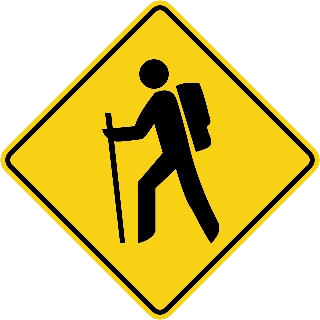
A hiking or recreational trail crosses the road ahead. Slow down and watch for walkers crossing.
Remember: A hiker with a pack and pole: a trail, not a sidewalk.
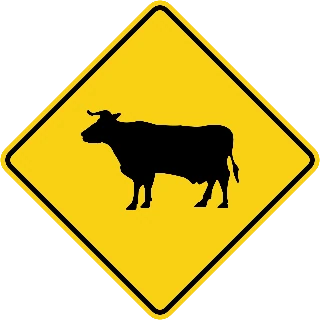
Farm animals may be on the road or crossing to pasture. Slow down and be ready to stop; animals can move unpredictably.
Remember: A cow on yellow: livestock on the road.
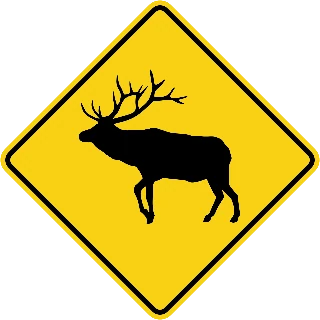
Elk often cross the road in this area, especially at dawn and dusk. Slow down, scan the ditches and be ready to stop; elk are large and heavy.
Remember: Large antlers, not a moose's flat ones: elk.
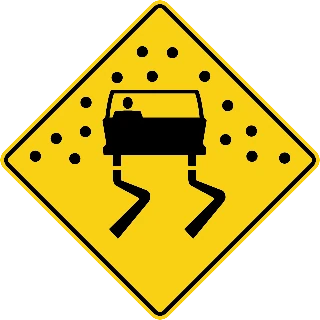
The surface ahead becomes slippery when wet or icy. Slow down, increase your following distance and avoid sudden braking, steering or acceleration.
Remember: Car with wavy skid marks: grip is lost here first.
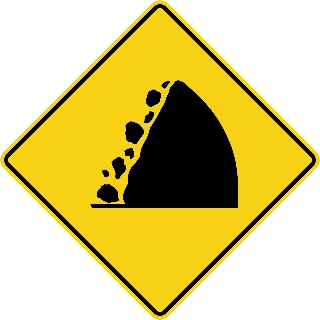
Rocks may fall from the slope onto the road. Watch the road ahead for fallen rock, do not stop in the area unless you must, and be ready to stop or steer around rocks safely.
Remember: Rocks tumbling off a cliff: look at the road, not the view.
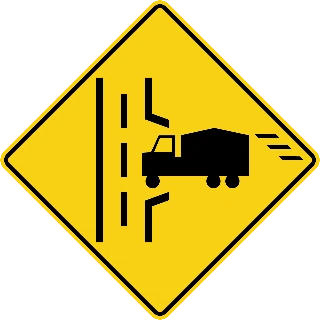
Heavy trucks may enter or leave the road from the right, for example at a quarry or plant. Watch for slow, wide trucks pulling out and give them room.
Remember: A truck coming out of the side: a truck driveway.
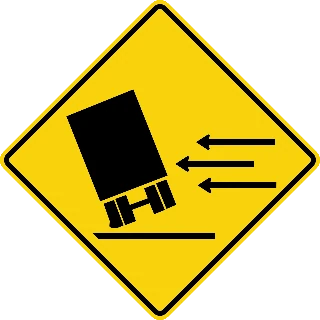
Strong gusts across the road, often on bridges and open stretches, can push vehicles sideways, especially trucks, trailers and motorcycles. Slow down, hold the wheel firmly and give high-sided vehicles room.
Remember: Wind lines hitting a truck from the side.
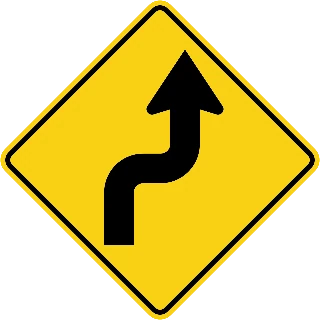
Two sharp curves in opposite directions, the first to the right. Slow down before the first curve and stay in your lane through both.
Remember: Arrow with two sharp bends: right, then left.
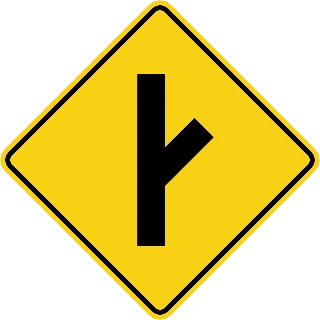
A side road joins from the right at a sharp angle. Drivers on it may have a poor view of you, so watch for vehicles entering.
Remember: A slanted stub: the side road meets yours at an angle.
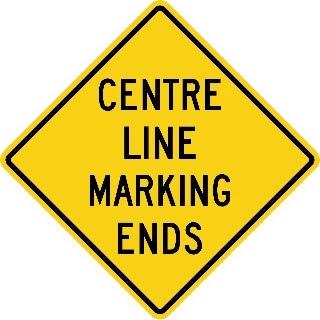
The painted centre line stops ahead. Keep to the right half of the road and take extra care with oncoming traffic.
Remember: No more paint in the middle: you judge the centre yourself.
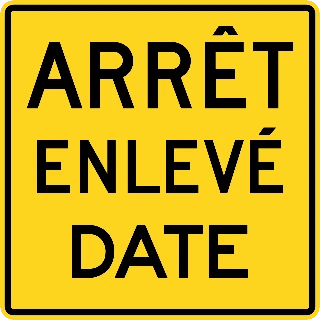
Only in Québec
Québec warning: the stop sign at this intersection was removed on the date shown. Traffic that used to stop there no longer does; drivers used to the old rule may not expect the change.
Remember: Yellow means warning: the stop is gone, your caution is not.
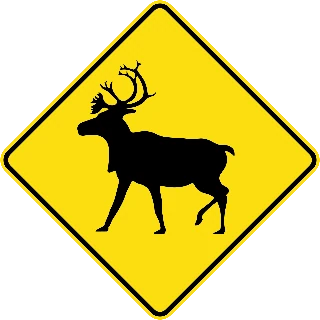
Only in Québec
Caribou may be on or near the road in this area. Slow down, especially at dawn, dusk and night, and scan the roadsides.
Remember: Antlers on a diamond: large animals, often in groups.
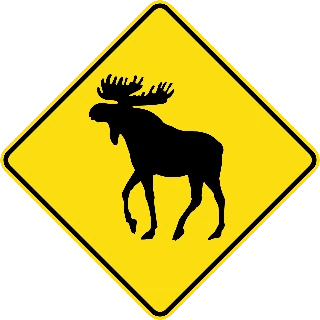
Only in Québec
Québec moose warning: moose may be on the road. Slow down, especially from dusk to dawn; a collision with a moose is very dangerous.
Remember: Tall legs, dark coat: hard to see at night, deadly to hit.

Only in Québec
Québec curve marker, white on red: the road turns sharply in the direction the chevron points (here, to the left). Slow down before the curve.
Remember: The point of the chevron shows the way the road goes.
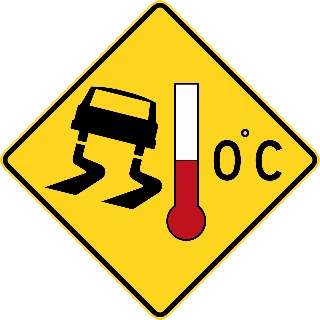
Only in Québec
Québec warning: the road can turn icy when the temperature is near or below 0 °C (black ice, often on bridges and shaded spots). Slow down and avoid sudden braking or steering.
Remember: Skidding car plus thermometer at 0 °C: invisible ice possible.
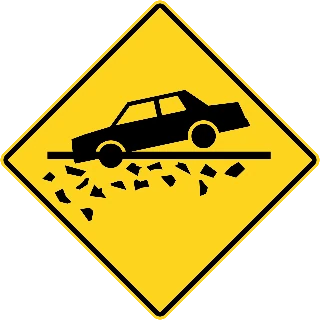
Only in Québec
Québec warning: loose gravel on the road can be thrown by tires and reduce grip. Slow down and keep a longer distance from the vehicle ahead.
Remember: Stones flying from the wheels: back off and slow down.
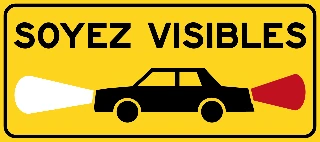
Only in Québec
Québec sign asking drivers to turn on their headlights so that other road users can see them, for example on a long or winding stretch.
Remember: A car beaming its lights: be seen, not just see.
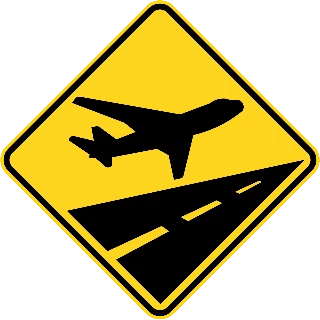
Only in Québec
Québec warning: an airport runway is close to the road and aircraft may pass low overhead. Do not be startled, and do not stop on the road to watch.
Remember: A plane over the road: noise and distraction ahead, keep driving.