The Class 7 Level I exam has two parts, in English or French: Road Sign Recognition (20 signs; stop, yield and school zone must be identified correctly, with no more than 4 other errors) and Rules of the Road (20 questions, 16 to pass). You can write it online or at Service New Brunswick. This practice test has the same two parts with 16 to pass in each; it does not check the three must-know signs separately, so make sure you know them.
Facts checked in November 2026 against each province's official site. Rules and fees change, so confirm with your province before your test.
Questions that apply in New Brunswick
Free questions with answers and explanations. Tap an answer to check it.
Applies in New Brunswick
1In New Brunswick, you may not drive on the left side of the road to pass when you are within what distance of an intersection or a railway crossing?
Explanation
New Brunswick's rules make it unlawful to drive to the left side of the roadway when approaching within 30 metres (100 feet) of, or crossing, any intersection or railway crossing, and within 30 m of a bridge, viaduct or tunnel when the view is obstructed.
New Brunswick Driver's Handbook, Part 4 — Traffic on the highway: rules of the road (4.4 Passing a vehicle)
Applies in New Brunswick
2New Brunswick's handbook compares a crash at 30 km/h to a car falling from the top of a one-storey building. What does it compare a crash at 60 km/h to?
Explanation
When speed doubles, the force of impact is four times as great, so 60 km/h is like falling from a four-storey building (NB handbook, Part 5).
New Brunswick Driver's Handbook Part 5 — Speed; 'Did you know' (force of impact)
Applies in New Brunswick
3Which statements about New Brunswick's Ignition Interlock Program are correct? Select all that apply.
Select all that apply
Explanation
In New Brunswick the interlock program is mandatory after a conviction for alcohol-impaired driving or refusal, participants bear the cost and hold a licence restricted to interlock-equipped vehicles. The Registrar may extend the time in the program or grant exemptions, including for medical reasons.
New Brunswick Driver's Handbook Part 5 §5.9 — Ignition Interlock Program
Applies in New Brunswick
4In New Brunswick, where does a crosswalk guard have the authority to stop traffic?
Explanation
New Brunswick's handbook states that crosswalk guards are authorized to stop traffic for pedestrians crossing at crosswalks only. When a guard signals you to stop there, stop and stay stopped until the way is clear.
New Brunswick Driver's Handbook, Part 4 — Traffic on the highway: rules of the road (4.17 Crosswalk guard)
Applies in Québec, New Brunswick
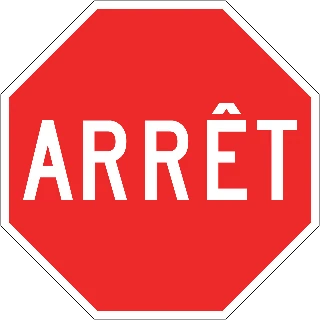
5What does this sign mean?
Explanation
In Québec the octagon reads ARRÊT; bilingual ARRÊT/STOP versions exist in New Brunswick. The rule is identical to the STOP sign: a complete stop, then proceed when safe.
6On an 80 km/h New Brunswick highway, a power-utility truck is stopped at the roadside with its flashing lights on. You are in the only lane going your way. What must you do?
Explanation
NB's handbook: for a stopped emergency OR service vehicle with flashing lights, slow to one half of the posted limit and move left away from it when safe. Service vehicles include tow trucks, public or private utility vehicles and contracted road maintenance vehicles.
New Brunswick Driver's Handbook, Part 4 §4.1 (stopped emergency and service vehicles)
Frequently asked questions
How many questions are on the knowledge test?
The Class 7 Level I exam has two parts, in English or French: Road Sign Recognition (20 signs; stop, yield and school zone must be identified correctly, with no more than 4 other errors) and Rules of the Road (20 questions, 16 to pass). You can write it online or at Service New Brunswick. This practice test has the same two parts with 16 to pass in each; it does not check the three must-know signs separately, so make sure you know them.
What do I need to bring to the test?
Some testing centres take walk-ins (Alberta registry agents, Ontario DriveTest centres), others need an appointment (SAAQ in Québec, ICBC in BC, Manitoba Public Insurance in most places). Bring original proof of identity, date of birth and signature (for example a passport, birth certificate, PR card or provincial health card) and, under 18, a parent's consent where required. A vision test is usually done the same day. Each attempt has a fee, which varies by province. Use the official link on your province's card in this app for the current rules and prices.
What happens if I fail?
There is no limit on attempts, but each one costs a fee and most provinces impose a wait: next day in Alberta and Saskatchewan, 7 days for GDL applicants in Manitoba, and 28 days in Québec and one day in BC. Ontario lets you retake either failed part (signs or rules) separately. Review the sections you missed in the app's weak-topic drill before rebooking.
Are these the real test questions?
No. Every question here and in the app is an original practice question written from the provincial handbooks. Real test questions are never reproduced. The questions practise the same rules, signs and numbers the handbooks teach.
Is Theory Hub connected to DriveTest, ICBC or the SAAQ?
Independent study app. Not affiliated with, endorsed by or connected to DriveTest, the Ontario Ministry of Transportation, ICBC, Alberta Registries, SAAQ, Manitoba Public Insurance, SGI or any provincial, territorial or federal government. All questions are original practice questions written from the official handbooks; real test questions are never reproduced. Rules and fees change — always confirm with your province's official site before your test.