The SAAQ theory exam for a Class 5 learner's licence is taken in French or English, by appointment. In Québec, the driving school's own theory test (end of Module 5) comes first. The SAAQ does not publish the number of questions; the pass mark is reported as 75%. This practice test has 30 questions and you need 23 to pass. Check the SAAQ website for the current format before your exam.
Facts checked in November 2026 against each province's official site. Rules and fees change, so confirm with your province before your test.
Québec: what is different
Québec drivers face rules the rest of Canada does not: stop signs read ARRÊT; right turn on red is banned on the whole island of Montréal (and wherever signed); winter tires are mandatory from 1 December to 15 March; Québec has no 0.05 'warn range' — the limit is the criminal 0.08, but 0.00 applies to learners, probationary drivers and everyone 21 and under. Fines are doubled in school zones and construction zones. The SAAQ knowledge test is booked online and written in French or English; a failed test can be retaken after 28 days.
Free questions with answers and explanations. Tap an answer to check it.
Applies in Québec
1A person is walking on the shoulder of a Québec road where the speed limit is 90 km/h. When you pass them, how much space must you leave?
Explanation
The SAAQ handbook says that when you pass or meet a pedestrian walking on the roadway or the shoulder, you must leave 1 m on a road of 50 km/h or less and 1.5 m on a road of over 50 km/h.
SAAQ Driver's Handbook ch. 4 'Passing a pedestrian' p. 225
Applies in Québec
2In Québec, driver A is caught at 92 km/h in a 50 km/h zone, and driver B at 132 km/h in a 90 km/h zone. Both are 42 km/h over. How many demerit points does each receive?
Explanation
Québec's table doubles points for 40 to 45 km/h over in a zone of 60 km/h or less (6 points; this is also excessive speeding there), while the same excess in a 90 km/h zone gives 3 points.
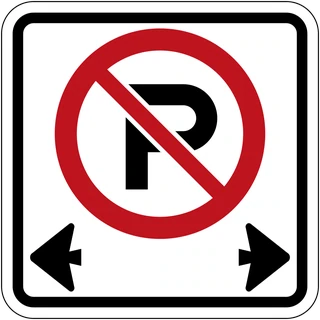
3In a Québec town, this parking sign has orange lights attached for snow-removal operations. The lights are off and no other rule applies. May you park here?
Explanation
SAAQ: regulated parking lights are orange lights combined with a regulatory sign; the parking regulation on the sign is in effect only when the lights are on, to free the street for maintenance.
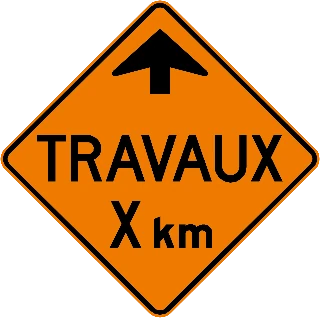
TRAVAUX with a distance warns that a work zone is coming up. Slow down, watch for signaleurs and lane changes, and remember fines are doubled in Québec work zones.
SAAQ Driver's Handbook (Guide de la route), signs; Tome V
Applies in Québec
5In Québec, a parent is paid to drive several school children to school in an ordinary passenger car. What must the owner install on the car?
Explanation
SAAQ: buses and minibuses carrying school children must have ÉCOLIERS signs front and rear. If school children are carried in a passenger vehicle, the owner must install one of these signs on the roof facing front and back, and remove or cover it when the car is not providing school transportation.
SAAQ Driver's Handbook (2nd ed.), ch. 2 (The vehicle) (Compulsory equipment and accessories)
Applies in Québec
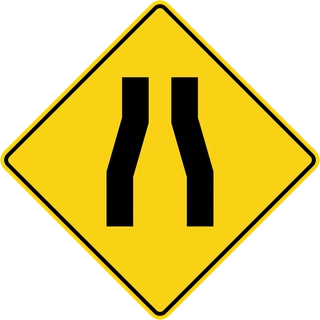
6This sign appears while you drive in the right lane of a Québec road with two lanes in your direction. What does it require of you?
Explanation
SAAQ explains that 'roadway narrows' signs do not require any manoeuvre; the number of lanes stays the same. Do not confuse them with lane-ending signs, which require drivers in the ending lane to change lanes after yielding.
SAAQ Driver's Handbook (2nd ed.), ch. 3 — Road signs (roadway narrows vs lane ending)
Frequently asked questions
How many questions are on the knowledge test?
The SAAQ theory exam for a Class 5 learner's licence is taken in French or English, by appointment. In Québec, the driving school's own theory test (end of Module 5) comes first. The SAAQ does not publish the number of questions; the pass mark is reported as 75%. This practice test has 30 questions and you need 23 to pass. Check the SAAQ website for the current format before your exam.
What do I need to bring to the test?
Some testing centres take walk-ins (Alberta registry agents, Ontario DriveTest centres), others need an appointment (SAAQ in Québec, ICBC in BC, Manitoba Public Insurance in most places). Bring original proof of identity, date of birth and signature (for example a passport, birth certificate, PR card or provincial health card) and, under 18, a parent's consent where required. A vision test is usually done the same day. Each attempt has a fee, which varies by province. Use the official link on your province's card in this app for the current rules and prices.
What happens if I fail?
There is no limit on attempts, but each one costs a fee and most provinces impose a wait: next day in Alberta and Saskatchewan, 7 days for GDL applicants in Manitoba, and 28 days in Québec and one day in BC. Ontario lets you retake either failed part (signs or rules) separately. Review the sections you missed in the app's weak-topic drill before rebooking.
Are these the real test questions?
No. Every question here and in the app is an original practice question written from the provincial handbooks. Real test questions are never reproduced. The questions practise the same rules, signs and numbers the handbooks teach.
Is Theory Hub connected to DriveTest, ICBC or the SAAQ?
Independent study app. Not affiliated with, endorsed by or connected to DriveTest, the Ontario Ministry of Transportation, ICBC, Alberta Registries, SAAQ, Manitoba Public Insurance, SGI or any provincial, territorial or federal government. All questions are original practice questions written from the official handbooks; real test questions are never reproduced. Rules and fees change — always confirm with your province's official site before your test.