CATheory Hub
English

Free G1 practice test (Ontario)

The G1 knowledge test is taken at a DriveTest centre, on paper or on a computer, with multiple-choice questions on road signs and rules of the road. DriveTest asks for 80% overall. This practice test has 40 questions, 20 on signs and 20 on rules, and you need 32 to pass. There is no published time limit.

40questions
32to pass
∞no time limit

Ontario G1 knowledge test

Answer every question, then press Finish. You will see your score, each part's result and an explanation for every question.

Part 1Road signs 20 questions

Applies in Ontario

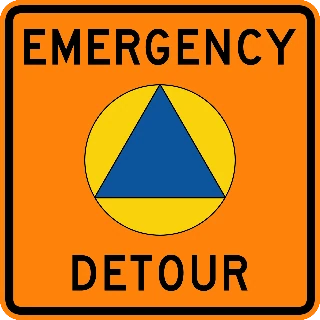
1What does this sign mean?
Explanation

Emergency Detour Route signs mark a pre-planned bypass. When police close the highway, they send traffic onto this route, and the markers lead you back to the highway.

Ontario MTO Driver's Handbook, Signs
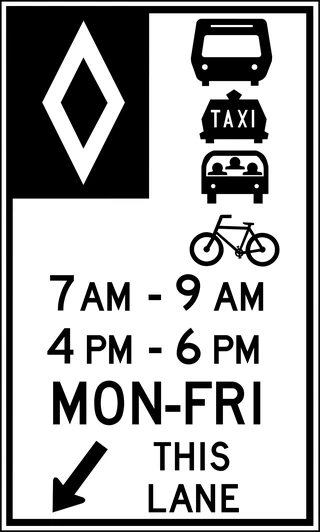
2This sign is posted over a city curb lane. What does it mean?

Explanation

The diamond marks a reserved lane. During the hours and days on the sign (here weekday rush hours), only the vehicles shown, such as buses, taxis, carpools and bicycles, may use it. Outside those times any vehicle may drive in it.

Ontario MTO Driver's Handbook — Signs (sign: hov_lane)

Applies in Ontario

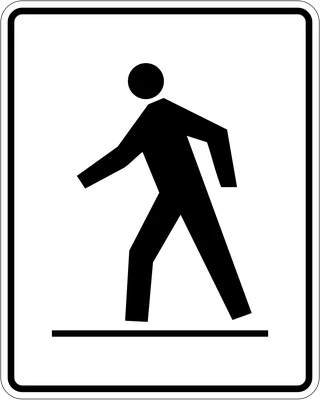
3You see this sign on an Ontario street. What must you do?

Explanation

At a pedestrian crossover you must stop and yield the whole roadway to pedestrians, and you may not pass another vehicle within 30 m of it.

Ontario MTO Driver's Handbook — Signs (sign: pedestrian_crossover)

Applies in Ontario

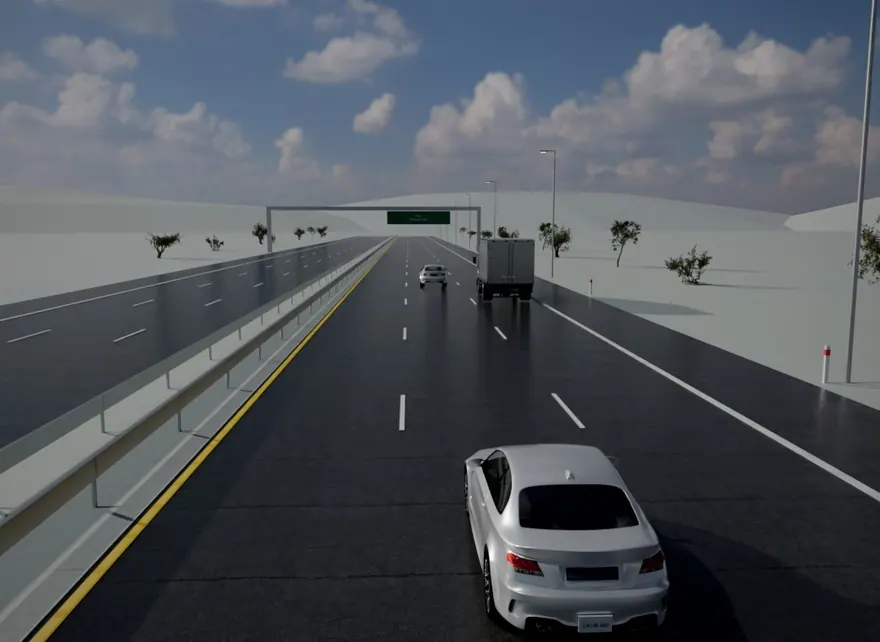
4On an Ontario highway, the truck ahead carries a rear placard identifying it as a long commercial vehicle (LCV). What should you expect when planning to pass it?

Explanation

The LCV placard marks a double-trailer combination up to 40 m long with limited speed. Anticipate its extended length before you decide to pass.

Ontario MTO Driver's Handbook — Signs (Other signs — long commercial vehicle placard)

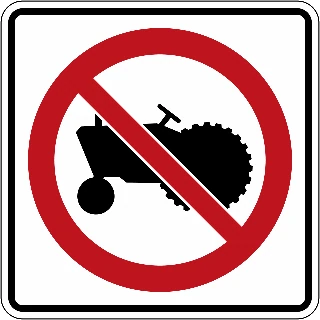
5Where are you most likely to see this sign?

Explanation

Freeways do not allow vehicles that cannot keep up with traffic, so this prohibition is posted where you join the freeway. On rural roads, slow vehicles carry the orange slow-moving-vehicle triangle instead.

Ontario MTO Driver's Handbook, Signs (regulatory); Freeway driving
6What is a stop line?

Explanation

A stop line is a single white line across the road at an intersection. When you must stop, stop with your front bumper behind it.

Ontario MTO Driver's Handbook — Pavement markings

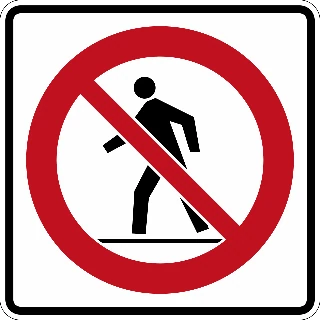
7What does this sign mean?

Explanation

A red circle with a slash over a walking person prohibits pedestrians from using or crossing the road at this point.

TAC MUTCDC, regulatory signs

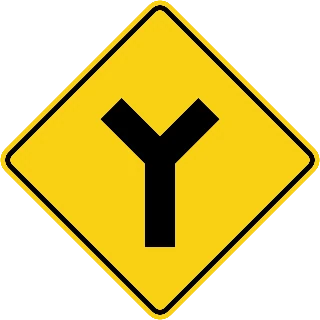
8What does this sign mean?

Explanation

The Y shape warns that the road forks. Choose your branch early, signal and watch for traffic using the other branch.

Ontario MTO Driver's Handbook, Signs (warning signs)
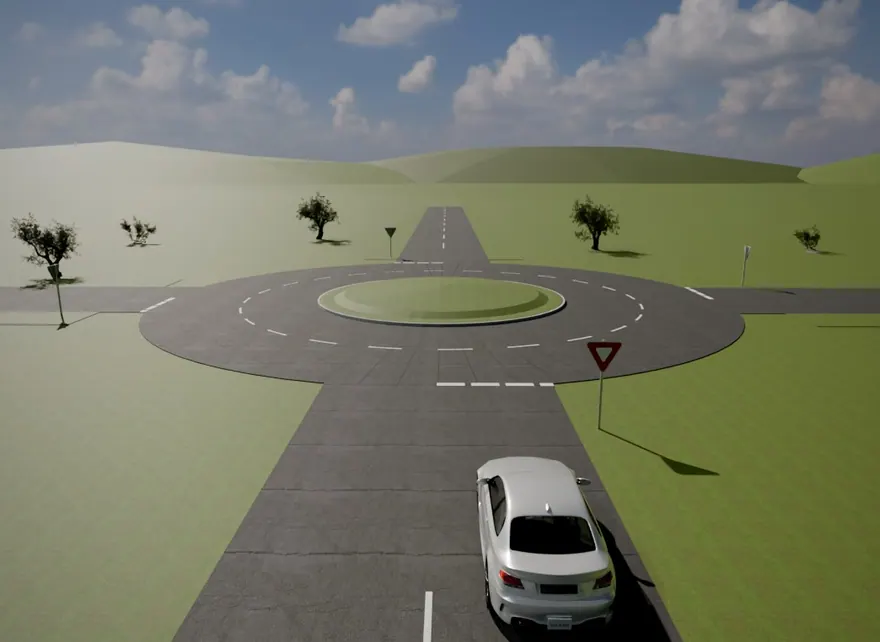
9You approach the painted yield line at a roundabout entrance and no vehicle is circulating. Must you stop?

Explanation

The yield line marks where you give way to traffic already in the roundabout; you stop only if needed to let a vehicle or pedestrian pass.

Ontario MTO Driver's Handbook — Changing directions (roundabouts: yield line)

Applies in Ontario, Alberta, British Columbia

10On a rural road, a large X is painted across your lane near a yellow railway warning sign. What does the marking tell you?

Explanation

Large X pavement markings are placed ahead of railway crossings along with the advance warning sign. Slow down and be prepared to stop for a train.

Ontario MTO Driver's Handbook — Stopping at railway crossings; SGI Saskatchewan Driver's Handbook 2026-27 §3.18; Alberta Driver's Guide (2026) Ch. 2 (OGL – Alberta)

Applies in Ontario

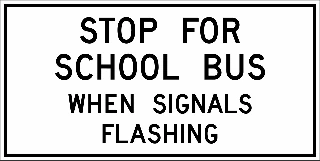
11On an undivided road you pass this sign. A school bus stopped in the opposite direction has its red lights flashing. What must you do?

Explanation

Without a median, traffic in both directions must stop for a school bus with flashing red lights. Only a median dividing the road lets oncoming traffic continue; from behind, stop at least 20 m back.

Ontario MTO Driver's Handbook, Signs; Driving through school zones and near school buses

12A curb lane is marked with a white diamond and the sign reads « BUS / TAXI ONLY, Mon–Fri 7–9 a.m. ». It is 10 a.m. on a Tuesday. May you drive a car in this lane?

Explanation

The diamond marks a reserved lane, but the sign defines who may use it and when; outside the posted hours the lane is open to all traffic.

Ontario MTO Driver's Handbook — Pavement markings (reserved lanes) and posted regulatory signs

Applies in Ontario

13In Ontario, how can you tell a pedestrian crossover from an ordinary crosswalk by its pavement markings?

Explanation

Ontario crossovers are identified by specific signs, overhead yellow lights and double parallel lines with X markings; ordinary crosswalks are two parallel white lines.

Ontario MTO Driver's Handbook — Pavement markings (pedestrian crossovers)

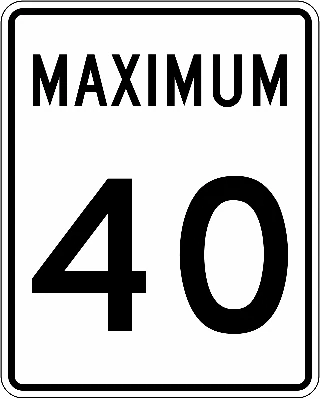
14What does this sign mean?

Explanation

A black number on a white rectangle under MAXIMUM is a regulatory speed limit: 40 km/h is the most you may drive here, and less when weather or traffic require it. Yellow signs give advisory speeds instead.

Ontario MTO Driver's Handbook, Signs
Applies in Ontario

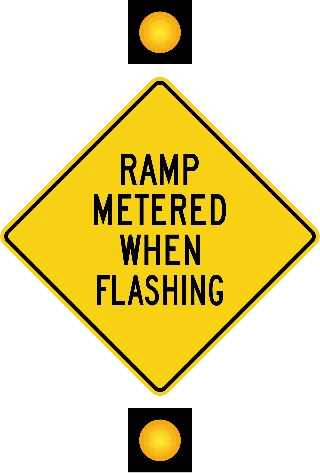
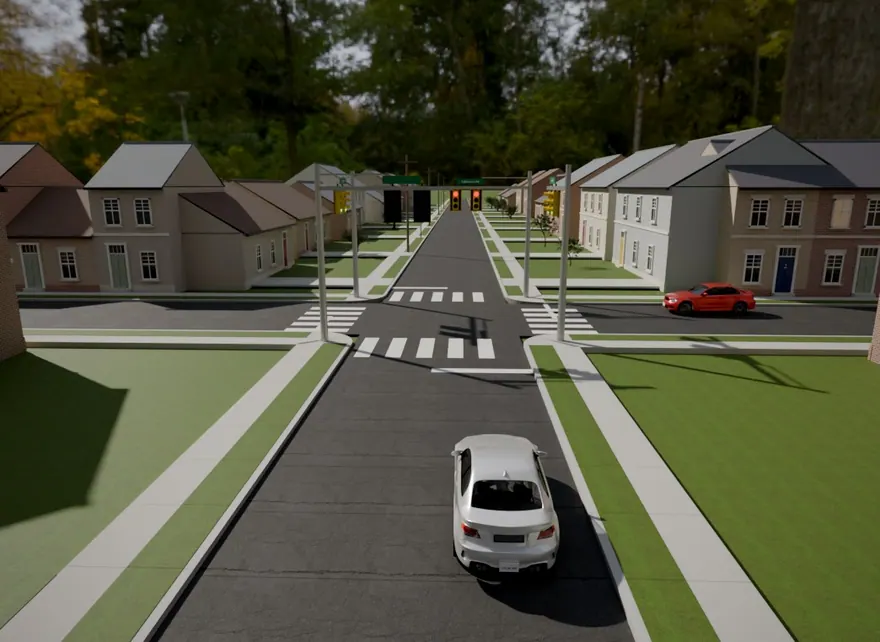
15You see this sign on a freeway entrance ramp with its lights flashing. What should you do?

Explanation

When this sign flashes, a ramp-metering signal is working ahead. Stop at the line on red and enter on green, one vehicle per green, so traffic joins the freeway smoothly.

Ontario MTO Driver's Handbook, Signs (warning signs)
Applies in Ontario

16In Ontario, you drive through an intersection on an amber light even though you could have stopped safely. On conviction, what fine does the Highway Traffic Act set?

Explanation

HTA s.144(15) requires you to stop at an amber light if you can do so safely. Disobeying it carries a fine of $150 to $500 (s.144(31.2)); running a red light is $200 to $1,000 (s.144(31.2.1)).

Ontario HTA s.144(15) and s.144(31.2)

Applies in Ontario

17On an Ontario two-lane road reduced to one lane for repairs, a roadside automated flagger device shows a red light and its gate arm is lowered. What must you do?

Explanation

Ontario HTA s.146.1(3.1): when an automated flagger assistance device shows a circular red light with the gate arm lowered, stop at the sign marking the stop (or before the device) and stay stopped until the red stops and the arm is raised. A flashing amber means pass slowly and with caution (s.146.1(4.1)).

Ontario Highway Traffic Act, R.S.O. 1990, c. H.8, s.146.1(3.1), (4.1)

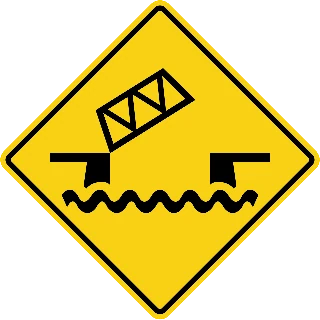
18What does this sign warn you of?

Explanation

The drawing of a span tilting above water marks an opening (lift or swing) bridge. Be ready to stop when its signals flash.

Ontario MTO Driver's Handbook, Signs (warning signs)
Applies in Ontario, Newfoundland and Labrador

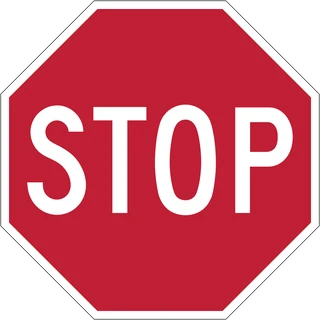
19A stop sign is posted at a railway crossing. No train is in sight and there is no stop line. Where must you stop?

Explanation

Ontario HTA s.163(2): at a stop sign at a railway crossing, stop at the marked stop line or, if none, not less than 5 m from the nearest rail. NL HTA s.133 also requires a stop not less than 5 m from the nearest rail. The stop is required even when no train is visible.

Ontario Highway Traffic Act, R.S.O. 1990, c. H.8, s.163(2); Newfoundland and Labrador Highway Traffic Act, RSNL 1990 c. H-3, s.133

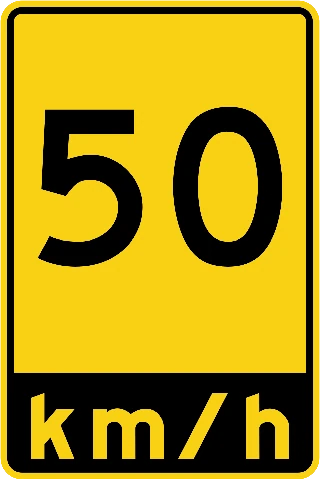
20The ramp is icy and has this sign. What speed is right?

Explanation

An advisory speed assumes dry pavement and good visibility. On ice, rain or snow you must go slower than the number shown to keep control.

Ontario MTO Driver's Handbook, Signs (warning signs)
Part 2Rules of the road 20 questions

21On which icy road should you expect the least grip?

Explanation

Ice looks the same at −2 °C and −22 °C, but roads are far more slippery near the freezing point than at −10 °C or −20 °C. Be especially careful with early-morning frost in fall and spring.

SGI Saskatchewan Driver's Handbook 2026-27 §6.8 Winter driving; Nova Scotia Driver's Handbook (2026) §5.3.5 Tips for dealing with slippery roads

Applies in Ontario, British Columbia, Alberta, Québec, Manitoba, Saskatchewan, Nova Scotia, New Brunswick, Prince Edward Island

22You are about to overtake a cyclist on a quiet road and want to warn them. The best use of your horn is to:

Explanation

A sudden blast beside a cyclist can startle them into a fall; a light tap from behind gives them time to react.

Ontario MTO Driver's Handbook — Sharing the road with other road users

Applies in Ontario

23Police stop an Ontario G1 driver, and the accompanying driver registers 'Warn' on a roadside screening device. What does the Highway Traffic Act provide?

Explanation

HTA s.48.2 lets police screen the accompanying driver. A Warn, Alert or Fail (50 mg or more) means the novice is directed not to drive; a second analysis on a different device, if requested immediately, governs.

Ontario Highway Traffic Act, R.S.O. 1990, c. H.8 s.48.2(1)-(3.2)

24You have a minor collision with no injuries and both cars can still be driven. What should you do with the vehicles?

Explanation

'Steer it, clear it': drivable vehicles left in live lanes cause secondary crashes. If a vehicle cannot be moved, set up warning signals far enough back to let traffic slow.

Ontario MTO Driver's Handbook — Dealing with emergencies (collisions)

Applies in Ontario

25An Ontario driver is caught driving while their licence is suspended under the Highway Traffic Act. Which consequences apply?

Explanation

You may not drive under any circumstances while suspended. Driving under an HTA suspension brings fines in the thousands, up to 6 months in jail, 6 months added to the suspension and a 7-day impoundment, even of a borrowed or rented vehicle.

Ontario MTO Driver's Handbook — Other ways to lose your licence (Driving under suspension; Vehicle-Impoundment Program)

26When giving hand signals from a car, which arm do you use?

Explanation

All three driver hand signals — left arm straight out for left, bent up for right, bent down for slow or stop — are given with the left arm out the driver's window.

Ontario MTO Driver's Handbook — Driving along (hand signals)

27A train is approaching a railway crossing. How far from the nearest rail must you stop?

Explanation

When a train is coming, lights flash or the gate is down, stop at least 5 m from the nearest rail or gate. A train can take up to 2 km to stop.

Ontario MTO Driver's Handbook — Stopping

Applies in Ontario

28In Ontario, when may you use the shoulder to pass another vehicle?

Explanation

Ontario allows driving on the right shoulder only to pass a vehicle turning left, and only if the shoulder is paved. You may never pass on the left shoulder, paved or not.

Ontario MTO Driver's Handbook — Changing positions (passing on the shoulder)

Applies in Ontario

29On a Sunday with no workers anywhere in sight, you are caught 20 km/h over the posted limit in a designated Ontario construction zone. How is the fine set?

Explanation

The posted construction-zone limit always applies. Under HTA s. 128(14.1), the per-km/h fine is doubled only when there is a worker in the construction zone; otherwise the normal s. 128(14) rates apply.

Ontario Highway Traffic Act, R.S.O. 1990, c. H.8, s. 128(14), (14.1)

Applies in Ontario

30In Ontario, a police car behind you turns on its lights to pull YOU over. Where should you stop?

Explanation

Being pulled over differs from yielding to a passing emergency vehicle: Ontario's handbook says to stop outside the traffic lanes on the shoulder where possible, or turn onto a quieter side street, and follow any directions from the officer.

Ontario MTO Driver's Handbook — Dealing with particular situations (being pulled over by police)

Applies in Ontario

31In Ontario, which of these is permitted while driving?

Explanation

Mounted or built-in GPS and hands-free devices are allowed; holding a phone, programming a GPS by hand or viewing a screen unrelated to driving are offences.

Ontario distracted-driving law (ontario.ca/page/distracted-driving); MTO handbook — Dealing with particular situations

Applies in Ontario

32What must Ontario drivers aged 80 or older do to keep their licence?

Explanation

Drivers 80 and over renew every two years. At the appointment they complete a vision test and a five-minute screening exercise; some may also need a road test or medical information. There is no charge for these requirements beyond the renewal fee.

Ontario MTO Driver's Handbook — Keeping your driver's licence (Senior drivers age 80 or older)

33Mirrors are adjusted correctly, but you still cannot see a car beside your rear corner. The only reliable way to check that space is to:

Explanation

Blind spots sit at the rear left and rear right, outside every mirror's view; a shoulder check is the only way to be sure they are clear.

Ontario MTO Driver's Handbook — Getting ready to drive

Applies in Ontario

34Entering an Ontario neighbourhood, you pass a sign showing a 40 km/h limit for the whole area. Further in, the side streets have no speed signs of their own. What is the limit on those streets?

Explanation

HTA s. 128(2.1) lets a municipality designate an area and set a limit below 50 km/h for all its streets that would otherwise be 50 km/h. Once the area is signed, the lower limit applies throughout, except on streets posted with their own limit.

Ontario Highway Traffic Act, R.S.O. 1990, c. H.8, s. 128(2.1), (11)

35You are backing out of your driveway across a sidewalk. Who must you yield to?

Explanation

Entering a road from a driveway you must yield to vehicles on the road and to pedestrians on the sidewalk; back slowly and look over your shoulder, especially for children.

Ontario MTO Driver's Handbook — Driving through intersections (entering from a driveway) and Changing directions (backing up)

Applies in Ontario

36In Ontario, you are about to pull away from a parked position at the curb. What does the Highway Traffic Act require first?

Explanation

HTA s.142(2): before setting a parked or stopped vehicle in motion, the driver must first see that the movement can be made safely and, if another vehicle may be affected, give a signal plainly visible to its driver.

Ontario Highway Traffic Act, R.S.O. 1990, c. H.8, s.142(2)

37This light comes on in the instrument panel. What does it mean?

Explanation

The rear fog light is on. Switch it off once visibility improves — it dazzles drivers behind and hides your brake lights.

Vehicle owner's manual (ISO 2575 symbols); provincial driver's handbook — vehicle maintenance

38Regardless of the posted limit, the speed you choose must always let you:

Explanation

The posted limit is a maximum for ideal conditions; in rain, darkness, heavy traffic or construction zones you must drive slower so you can stop within your sight distance.

Ontario MTO Driver's Handbook — Driving along (speed)

Applies in Ontario

39An Ontario G2 driver gives a roadside saliva sample, and the approved drug screening equipment shows a drug. It is their second suspension of this kind within 10 years. How long is the licence suspended?

Explanation

Under HTA s.48.0.2, a novice driver whose oral fluid shows a drug has the licence suspended for 7 days (first), 14 days (second) or 30 days (third or later); suspensions more than 10 years old are not counted.

Ontario Highway Traffic Act, R.S.O. 1990, c. H.8 s.48.0.2(1)-(3) (as amended 1 Jan 2026)

Applies in Ontario

40In Ontario, a driver opens their door into the path of a cyclist without checking. What fine does the Highway Traffic Act set for opening a door unsafely?

Explanation

Ontario HTA s.165(2): anyone who opens a vehicle door without due precautions, or leaves it open on the traffic side longer than needed, is liable to a fine of $300 to $1,000. Check your mirror and shoulder before opening any door.

Ontario Highway Traffic Act, R.S.O. 1990, c. H.8, s.165(1)-(2)