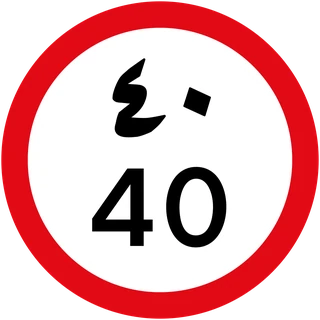
Maximum speed 40 km/h
Do not exceed 40 km/h. This is the default limit on urban single-carriageway roads and the usual limit in residential and school zones.
Memory hint: 40 = around homes and schools.
8 signs
Do not exceed 40 km/h. This is the default limit on urban single-carriageway roads and the usual limit in residential and school zones.
Memory hint: 40 = around homes and schools.
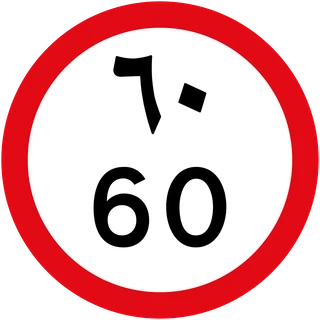
Do not exceed 60 km/h — typical on urban dual carriageways. Stopping distance at 60 km/h is about 33 metres.
Memory hint: 60 in the city, 33 metres to stop.
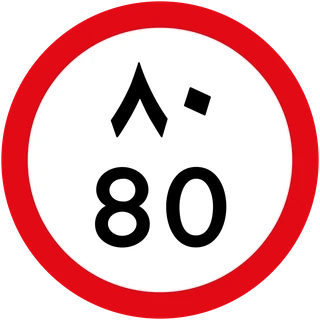
Do not exceed 80 km/h, common on major urban arteries and for heavy vehicles on freeways. In standing water, aquaplaning starts around 80 km/h — slow down.
Memory hint: 80 = big city roads and the truck limit on freeways.
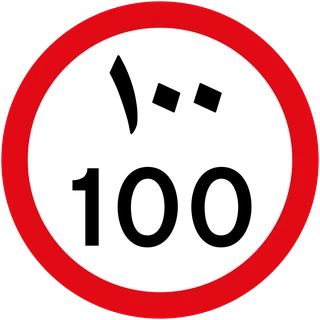
Do not exceed 100 km/h, as on the urban stretch of Sheikh Zayed Road and Al Khail Road. Stopping distance is about 87 metres.
Memory hint: 100 on SZR in town; nearly 90 m to stop.
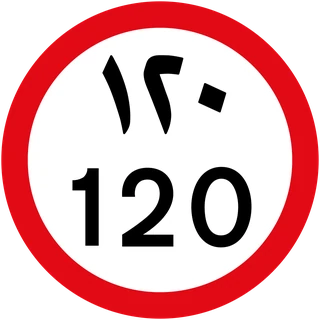
The highest common limit for light vehicles on UAE freeways. Heavy vehicles stay at 80 km/h. Stopping distance is about 130 metres, so keep at least 3 seconds behind.
Memory hint: 120 for cars, 80 for trucks, 130 metres to stop.
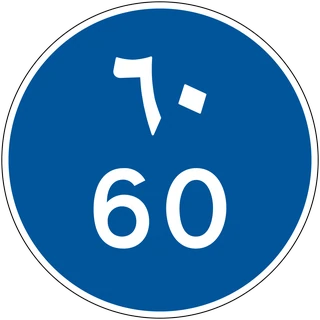
You must drive at least 60 km/h unless conditions make it unsafe. Driving below the minimum, or hogging the left lane slowly, costs AED 400.
Memory hint: Blue circle = must; the number is the floor, not the ceiling.
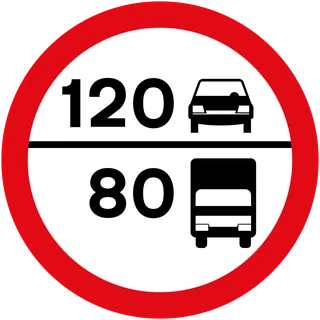
Different limits apply to different vehicles — typically 120 km/h for cars and 80 km/h for trucks and buses on freeways. Find your vehicle's row.
Memory hint: One sign, several numbers — read the line with your vehicle.
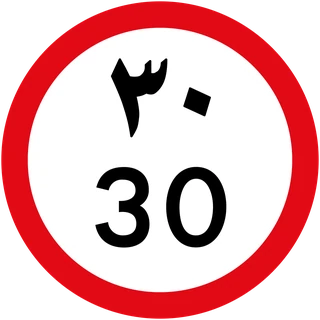
Do not exceed 30 km/h. Used where people on foot are close to the traffic, such as residential streets.
Memory hint: Red ring = a limit you must not pass; the number is the limit.