AETheory Hub
English

Free UAE theory mock test

35 questions with three answer options, like the Dubai RTA Knowledge Test. You need 27 correct answers (75%), the same share as the 30 of 40 needed in Dubai. The real Dubai test also has 5 hazard videos; those are in the app.

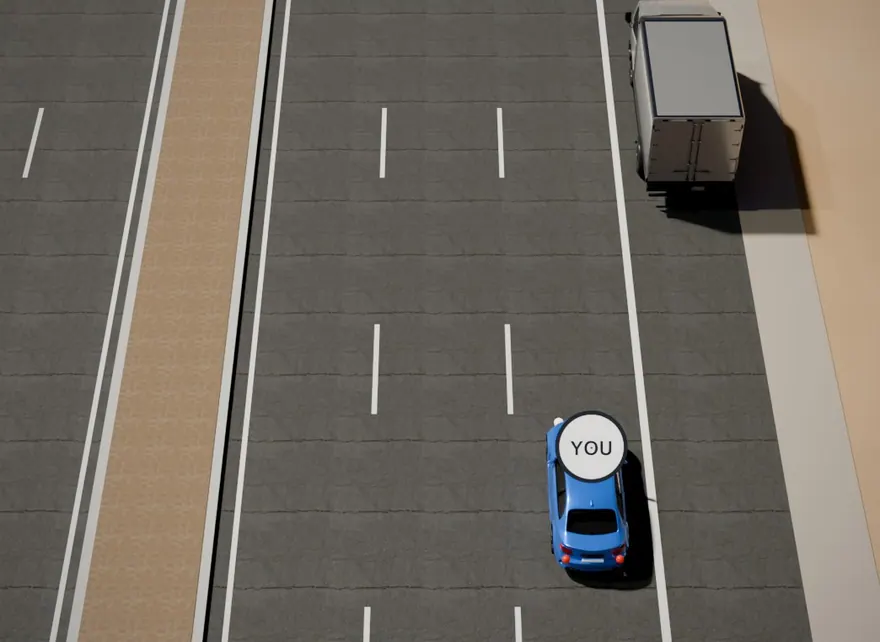
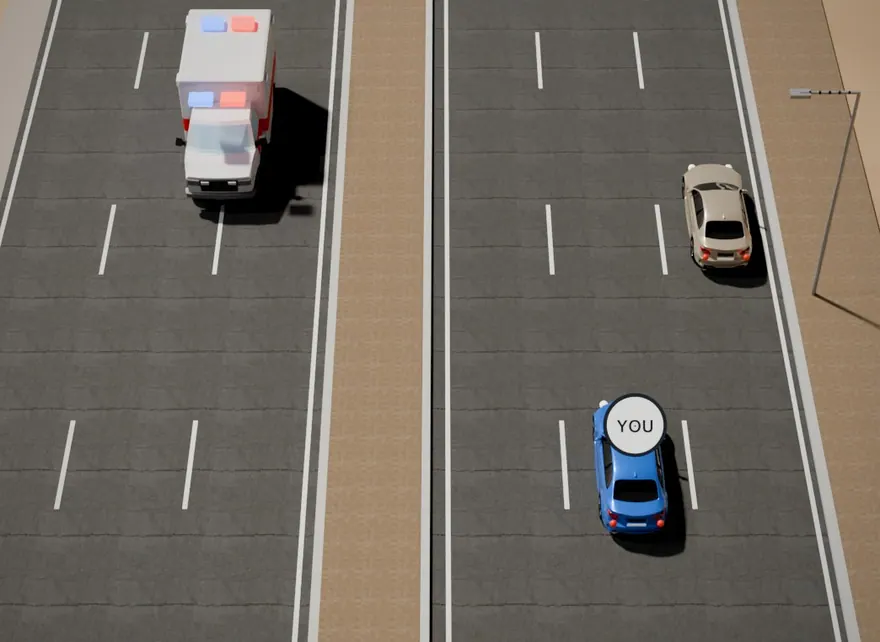
1You are on a freeway with a solid central barrier. An ambulance with its siren on passes on the opposite carriageway. What should you do?
Explanation

Giving way means clearing the emergency vehicle's path. When a barrier separates the carriageways its path does not involve you, so the safe response is to keep a steady speed and avoid being distracted by watching it.

RTA Light Motor Vehicle Handbook, Part 4; divided carriageways
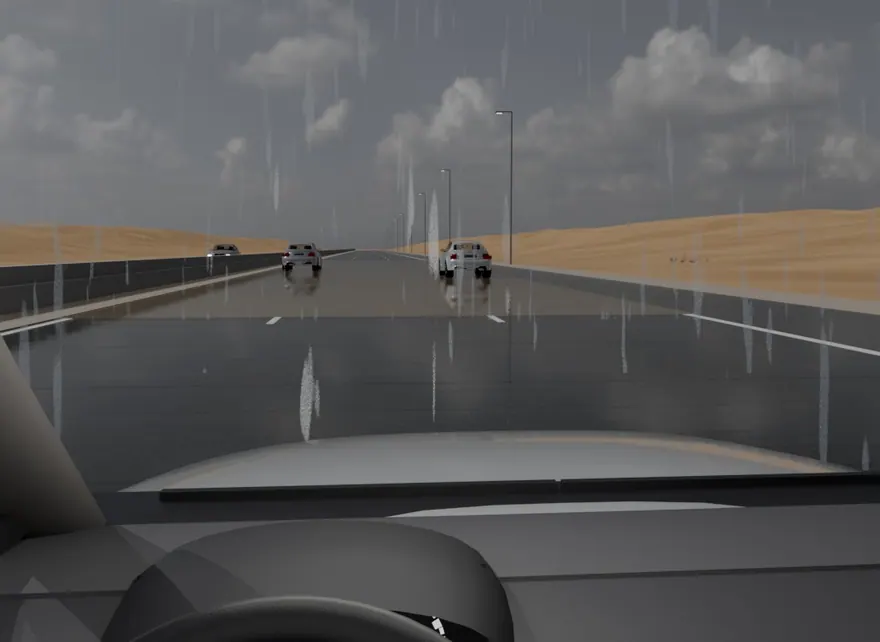
2After heavy rain there is standing water on the road. Below what speed does the RTA handbook advise driving to avoid aquaplaning?

Explanation

Above roughly 80 km/h the tyres can ride up on a film of water and lose contact with the road. Slow down before the puddle, not in it.

Driving Safely in Dubai (RTA, 2025), Part 2

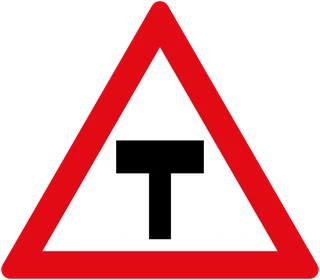
3This sign appears ahead of you. What should you expect?

Explanation

The T shape shows your road as the stem that stops at a crossing road. Traffic on the through road has priority, so slow down and prepare to turn (RTA handbook).

Driving Safely in Dubai (RTA, 2025), Part 4

4On a designated truck route a slow truck is driving along the roadside shoulder. What should you expect?

Explanation

The handbook: slower trucks often use the shoulder to let other trucks overtake, but then need to move back into the traffic lanes, so watch out for this on busy truck routes.

RTA Light Motor Vehicle Handbook (rta.ae PDF), Part 5 — Overtaking Trucks; Part 4 — Trucks and Buses / Towing a Trailer

5An 8-year-old child who is 150 cm tall sits belted in the front passenger seat. What applies?

Explanation

Both conditions must be met — 10 years and 145 cm — before a child may ride in front. The fine is AED 400; Abu Dhabi additionally impounds the vehicle.

Ministerial Resolution 178/2017 — child under 10 or under 145 cm in the front seat (AED 400)

6You are driving at night on an unlit highway. Which of these is the most dangerous hazard?

Explanation

An unlit vehicle partly in the lane is very hard to see until late. This is why drivers are told to use hazard lights and triangles, and why you must drive at a speed that lets you stop within the distance you can see.

RTA Light Motor Vehicle Handbook (3rd ed.), Part 5 — Using Emergency Signals; Part 3 — Drive Safely at Night

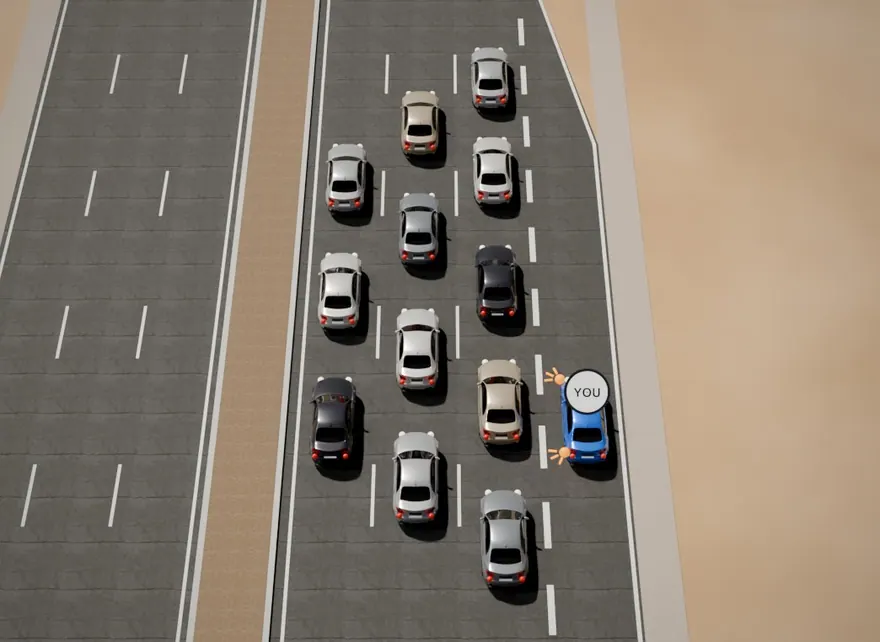
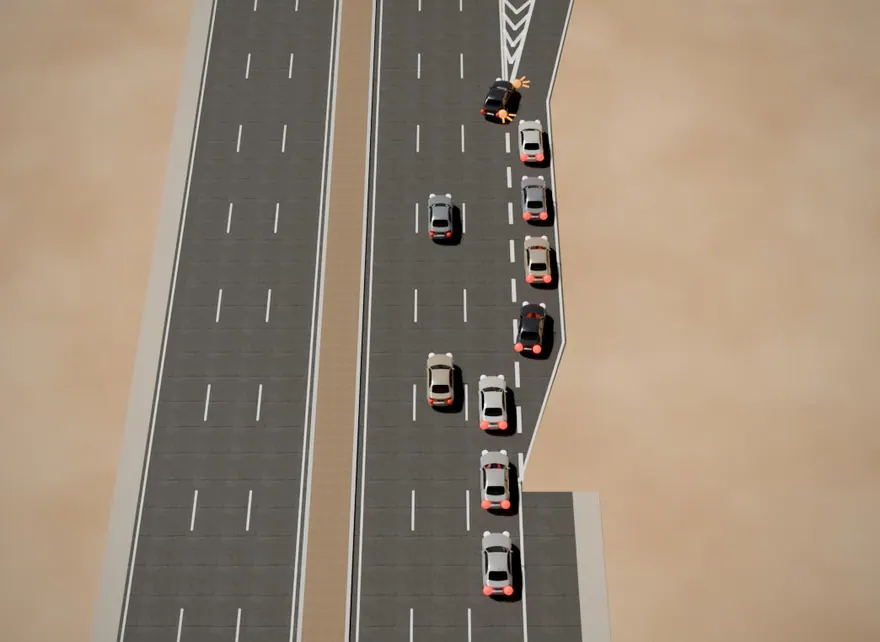
7You are on an entry ramp, and the freeway traffic you are joining is crawling along at about 40 km/h because of congestion. How fast should you be going when you merge?

Explanation

The aim of the ramp is to reach the speed of the traffic you join, not the posted maximum. Arriving much faster than a slow queue forces hard braking; match its speed and merge without making others brake.

RTA Light Motor Vehicle Handbook (3rd ed.), Part 5 — Entering a Freeway (match the speed of freeway traffic)

8The centre of the road is marked with a broken white line. What does this allow?

Explanation

A broken line is advisory: you may cross it to overtake or turn when safe. A solid line, by contrast, must not be crossed (RTA handbook, road markings).

RTA Light Motor Vehicle Handbook, Part 5

9A tourist on a two-week visit to the UAE wants to rent and drive a car. Which license may he drive on?

Explanation

The UAE has approved a list of countries whose licenses are acceptable during transit and visits, and an international driving license may also be used. Residents, by contrast, must hold a UAE license.

Federal Decree-Law 14/2024 — Legal500 law-firm summary 'New Regulations on Driving License and Vehicle Registration'

10Traffic is queuing to leave Sheikh Zayed Road at an exit. A driver races up the empty lane beside the queue and forces in at the front. Why does the handbook condemn this?

Explanation

Cutting in or jumping the queue just to get a few metres ahead is on the handbook's list of unacceptable behaviours: it aggravates the traffic and suddenly shortens the stopping space of vehicles such as trucks, raising the crash risk.

RTA Light Motor Vehicle Handbook (rta.ae PDF), Part 4 — Unacceptable Driving Behaviors / Role Model Driving Behavior

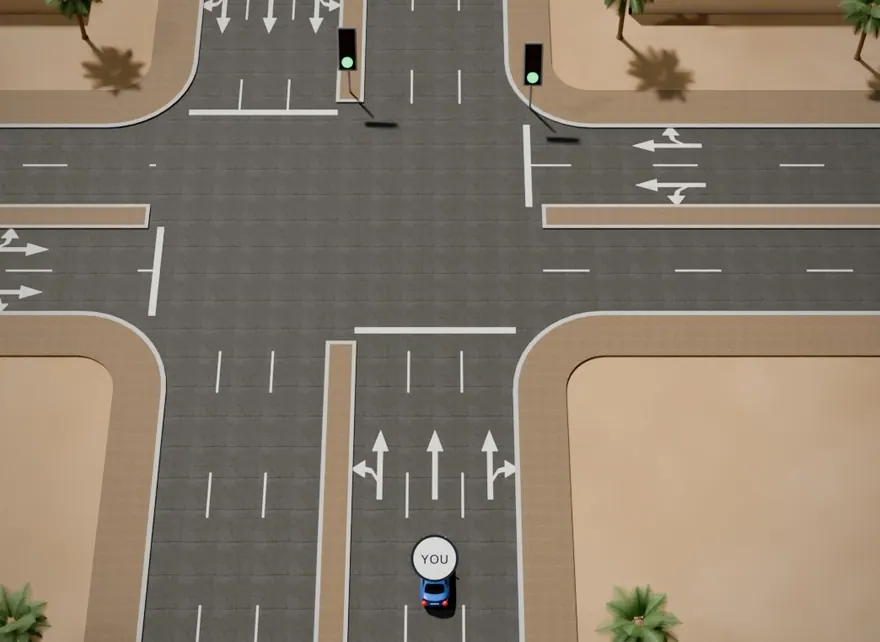
11At a junction the right-hand lane is marked for turning right and the middle lane for straight ahead. A driver turns right from the middle lane. How is this treated?

Explanation

Lane arrows decide which movements are allowed from each lane. Turning across a lane whose traffic is turning the same way, or going straight, causes side-on collisions and is fined as a wrong turn.

Ministerial Resolution 178/2017 — turning from an undesignated lane / in the wrong way (AED 500, 4 pts)

12You are waiting to turn left at a junction. The lights for the oncoming traffic turn amber just as a heavily loaded truck approaches them at speed. What should you do?

Explanation

Trucks are heavy and need much more braking time and space, so a truck near the line may be unable to stop safely on amber. Never turn across its path until you know what it is doing.

RTA Light Motor Vehicle Handbook (3rd ed.), Part 4 — Stopping Distances (trucks need more time and space to stop)

13Your toddler has outgrown the weight limit of the rear-facing, infant-only car seat you have used since birth. What does the handbook say you need?

Explanation

When a toddler reaches the highest weight of the rear-facing seat, switch to a forward-facing position; if you used a rear-facing infant-only seat, you need a new forward-facing seat. Children under 4 must always ride in a child seat.

RTA Light Motor Vehicle Handbook (rta.ae PDF), Part 3 — Seat Belts: Car Safety for Your Toddler

14At a junction there is a NO LEFT TURN sign, and beneath it a plate saying that U-turns are permitted. You want to turn back the way you came. What applies?

Explanation

The handbook says you must not make a U-turn at a No Left Turn sign unless there is a U-turn Permitted sign. With that sign the U-turn is allowed, made from the proper lane and after giving way, while the left turn stays prohibited.

RTA Light Motor Vehicle Handbook (rta.ae PDF), Part 5 — U-turns

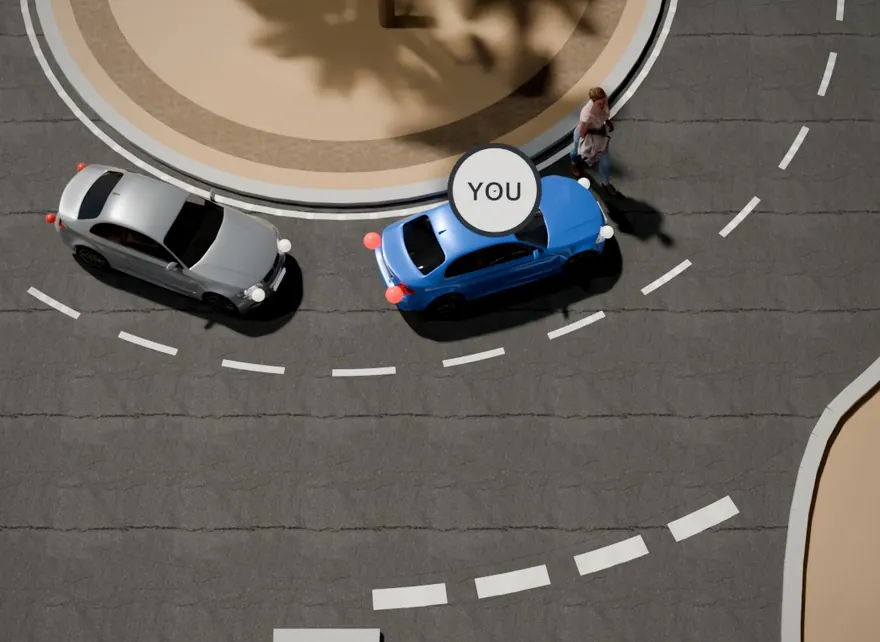
15Your passenger wants to be dropped off on the roundabout itself, next to the central island. What should you do?

Explanation

A roundabout is a flowing junction where every vehicle is turning and watching the traffic to its left; a stopped car there is a serious hazard. Stopping in the road without reason costs AED 1,000 and 6 black points.

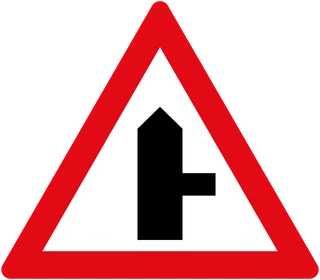
16What hazard does this sign warn of?

Explanation

The thick line is your main road and the thin stub on the right is a side road. Traffic from it should give way to you, but be ready in case a driver pulls out.

RTA Light Motor Vehicle Handbook (rta.ae PDF), Part 5 — Road Signs; signs.json W_side_road_right

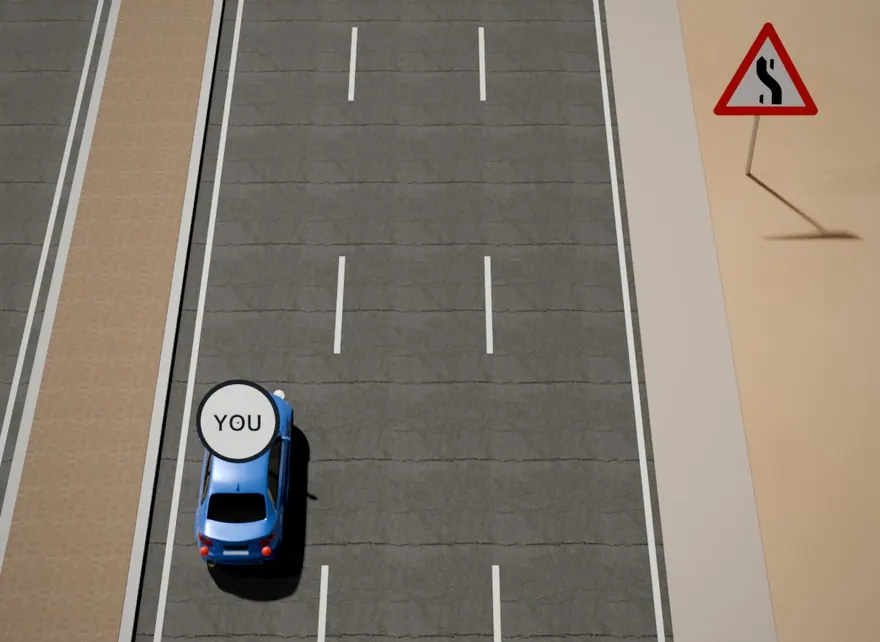
17On a dual carriageway you pass a warning sign for a diversion to the opposite carriageway ahead. What should you expect?

Explanation

The sign warns that traffic will be moved across the central reservation onto the other carriageway, usually for roadworks. Oncoming traffic will then be close on your left: slow down, keep to your lane and do not overtake.

RTA Light Motor Vehicle Handbook (rta.ae PDF), Part 5 — Warning Signs (diversion to opposite carriageway ahead)

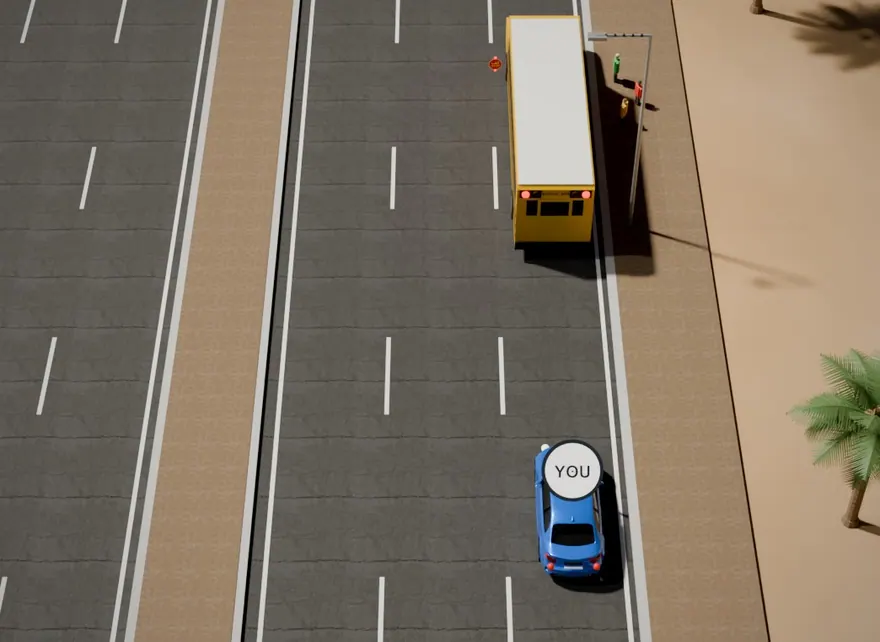
18A school bus ahead stops and extends its red STOP arm while children get off. What must you do?

Explanation

When the STOP arm is out, traffic behind the bus must stop and keep a safe distance (Abu Dhabi Police advise at least 5 m); on a single-lane road oncoming traffic must stop too. Children cross unpredictably around a bus; the penalty for not stopping is AED 1,000 and 10 black points.

Ministerial Resolution 178/2017 — not stopping for a school bus STOP sign: AED 1,000 + 10 black points (reiterated by Abu Dhabi Police, Aug 2026)

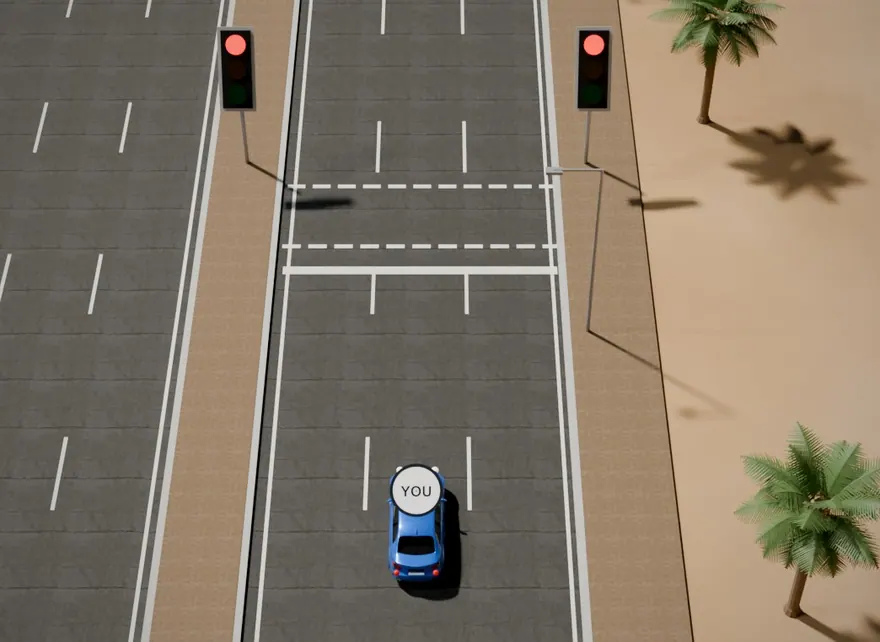
19You are approaching a pedestrian crossing whose signal has been flashing yellow. Suddenly it changes to red. What is the most likely reason, and what must you do?

Explanation

At these crossings the flashing yellow light means proceed with caution. The handbook explains that the lights change to red when a pedestrian approaches to cross, and a red signal means you must stop.

RTA Light Motor Vehicle Handbook (rta.ae PDF), Part 5 — Giving Way to Pedestrians (flashing yellow crossing lights)

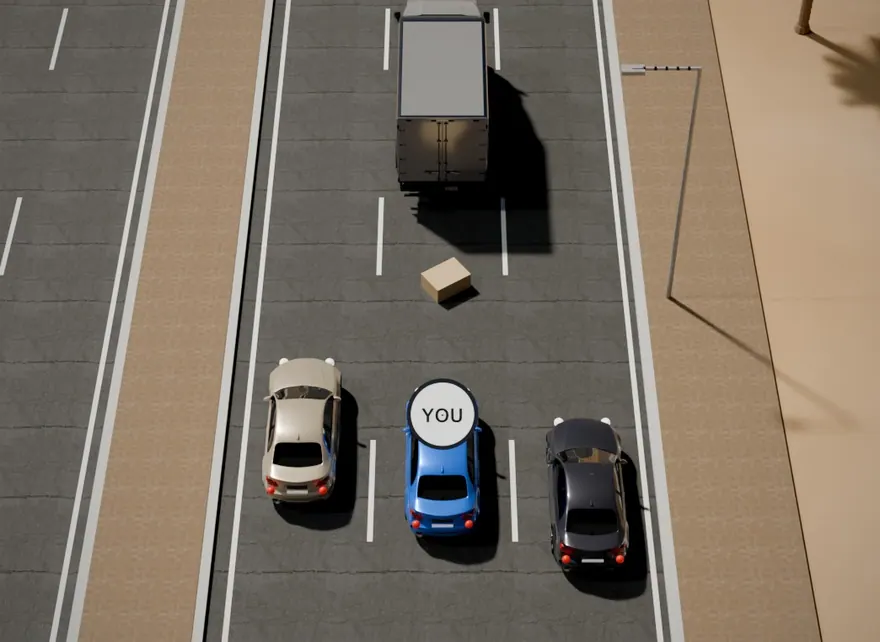
20At 100 km/h a box falls from the truck ahead into your lane. Cars are close beside you on both sides. What is generally the safest reaction?

Explanation

A sudden swerve into an occupied lane can cause a worse crash than the obstacle itself, and sudden deviation is listed as an offence in the federal schedule. Keeping a safe gap gives you room to brake in your own lane.

RTA Light Motor Vehicle Handbook (rta.ae PDF), Part 3 — Reducing Your Risk of a Crash (safety margin); Ministerial Resolution 178/2017

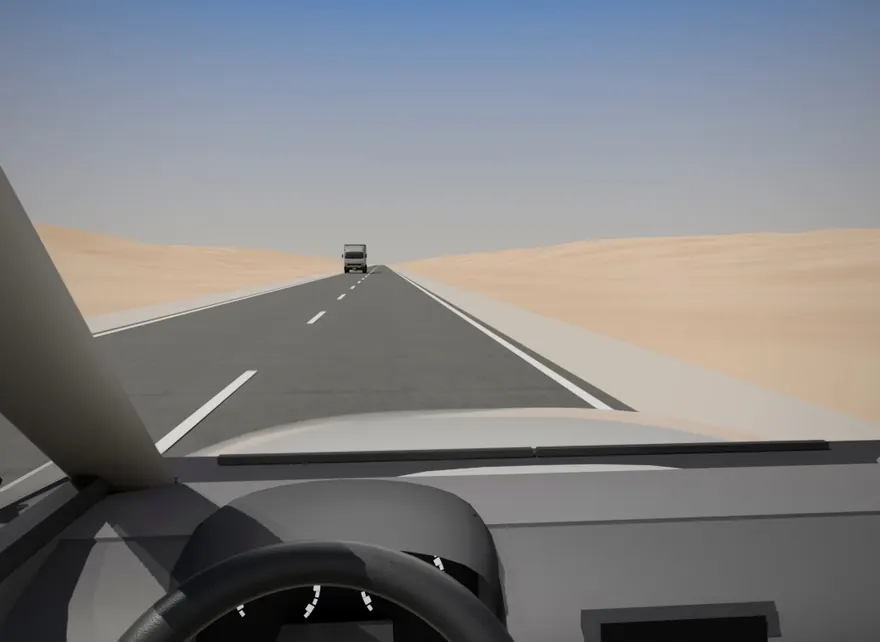
21At night on an unlit desert highway, your headlights pick out a dead camel lying across your lane. There is traffic in the next lane. What should you do?

Explanation

A large animal in the lane is a serious hazard for every driver behind you. Braking in a straight line keeps control, and the lane change must wait for a safe gap. Police need to know so the road can be cleared.

RTA Light Motor Vehicle Handbook (3rd ed.), Part 3 — Drive Safely at Night; emergency number 999

22An ambulance with siren and flashing lights comes up behind you on a busy road. What is the correct action?

Explanation

Emergency vehicles showing lights and sirens must be given way, moving right and stopping if needed. Not giving way costs AED 3,000, 6 black points and a 30-day impound.

RTA Light Motor Vehicle Handbook, Part 4

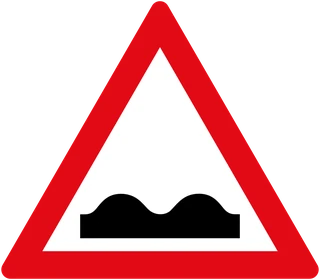
23You are towing a trailer and pass this sign. How should you adjust your driving?

Explanation

The handbook says bumps in the road, side winds and passing trucks can affect a trailer's stability, and that towing drivers should avoid fast lanes and sudden swerving. Slow down before the rough surface.

RTA Light Motor Vehicle Handbook (rta.ae PDF), Part 4 — Towing a Trailer; signs.json W_uneven_road

24A sign is a solid blue circle with a white symbol. What does this shape and colour tell you?

Explanation

Blue circles are mandatory signs: keep right, turn left, minimum speed, roundabout and so on. Prohibitions use a red border, and brown signs are tourist wayfinding (RTA handbook).

25At 120 km/h on a freeway, roughly what total stopping distance does the RTA handbook give for a light vehicle?

Explanation

Doubling your speed roughly quadruples braking distance: the handbook lists about 130 m at 120 km/h compared with 33 m at 60 km/h. This is why you keep a following distance of at least 3 seconds: a gap counted in seconds grows with speed.

RTA Light Motor Vehicle Handbook, Part 3

26A driver is recorded at 115 km/h on a road with an 80 km/h limit (35 km/h over). What is the fine?

Explanation

Exceeding the limit by more than 30 but not more than 40 km/h costs AED 700 under the federal schedule; black points start only above 50 km/h over.

Ministerial Resolution 178/2017 — exceeding the limit by not more than 40 km/h (AED 700)

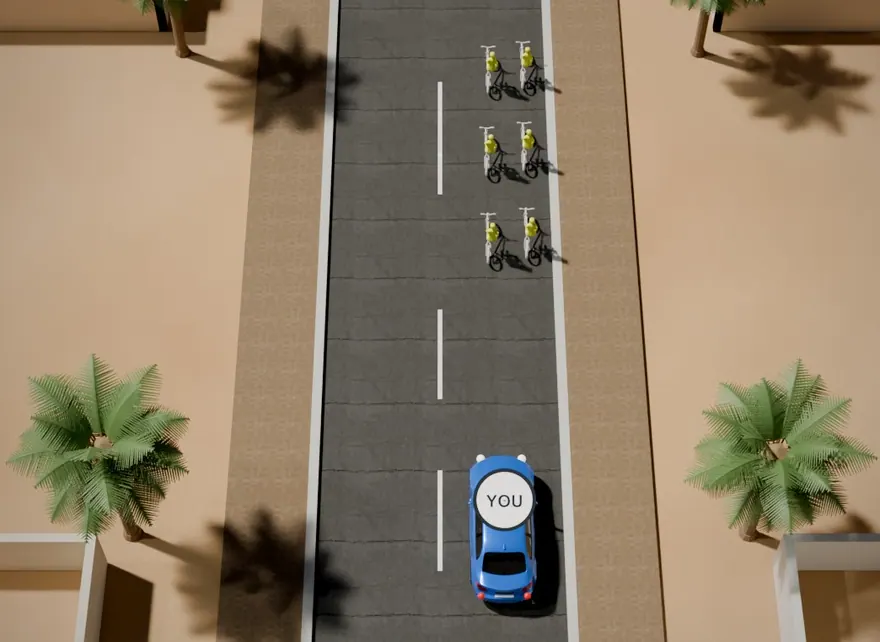
27You catch up with a group of cyclists riding two abreast on Al Qudra Road. How should you pass them?

Explanation

Cutting into a group forces riders to brake and can bring several down at once. Treat the group as one long vehicle and pass only when the road ahead is clear.

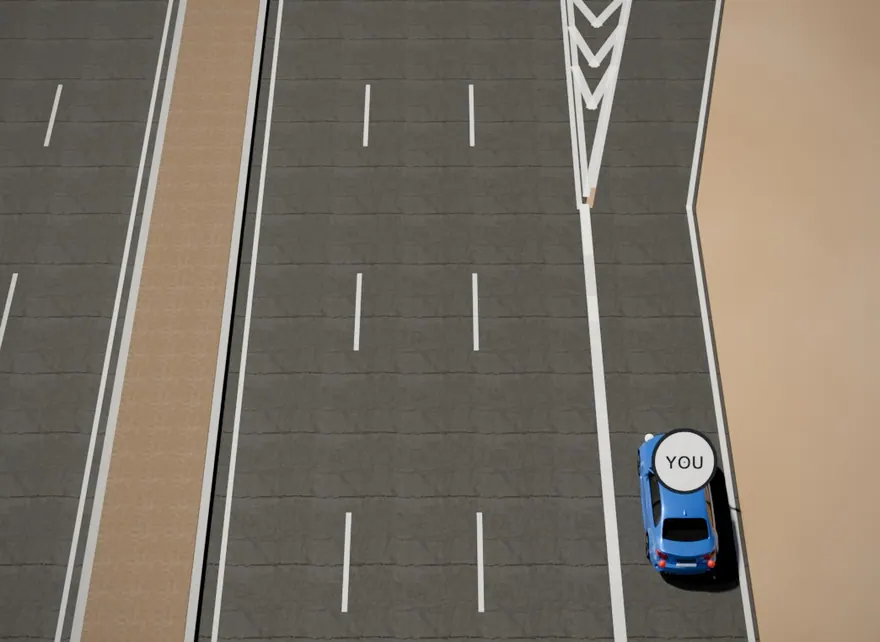
28You drifted into a freeway exit lane by mistake. You realise it only when a solid white line already separates your lane from the main carriageway. What should you do?

Explanation

A solid line between lanes may not be crossed, and stopping or reversing on a freeway is dangerous and prohibited. Follow the exit and rejoin the freeway further on.

RTA Light Motor Vehicle Handbook (3rd ed.), Part 5 — Road Markings (solid lines); Leaving a Freeway

29Before driving across a long desert highway with few services, what should you do about fuel?

Explanation

A breakdown from an empty tank is a self-inflicted emergency. Plan fuel, water and rest stops before a long trip, especially in summer.

Driving Safely in Dubai (RTA, 2025), Part 1

30You approach a junction where the light has been green for a long time. What should you do?

Explanation

A 'stale' green is likely to change. Knowing what is behind you lets you decide safely whether to stop on amber; accelerating towards a changing light is how red-light offences and side-impact crashes happen.

RTA Light Motor Vehicle Handbook, Part 5

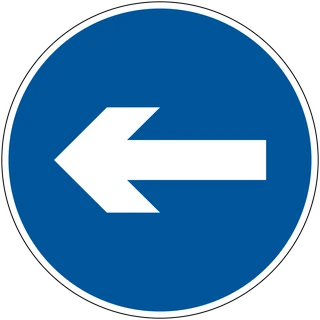
31What does this sign require?

Explanation

A blue circle with a white arrow is a mandatory turn, here to the left. In the UAE (right-hand traffic) a left turn crosses oncoming vehicles, so the handbook tells you to wait for a safe gap or a green arrow.

Driving Safely in Dubai (RTA, 2025), Part 4

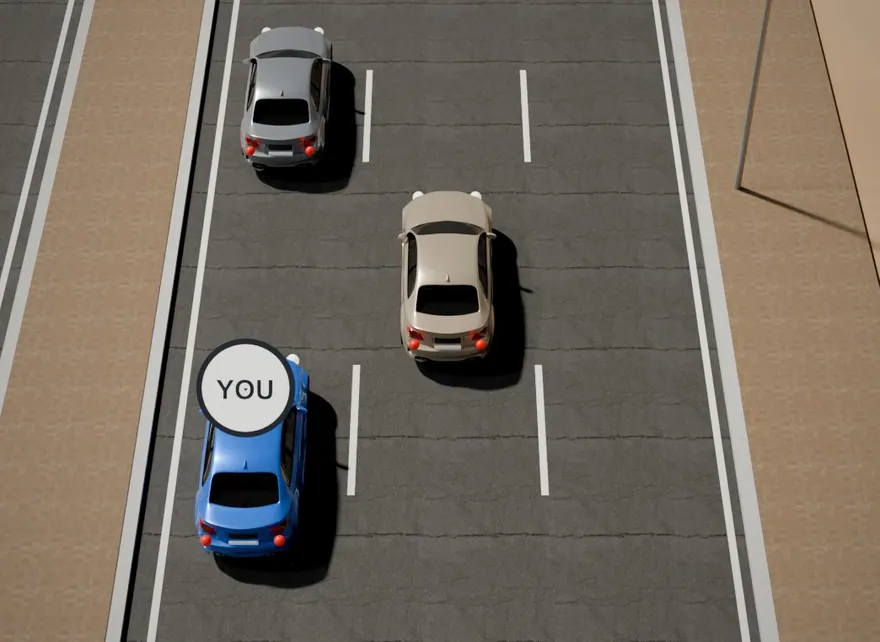
32A slow car is ahead of you in the far-left lane and there is no lane to its left. What should you do?

Explanation

Undertaking on the right is wrong overtaking (AED 600, 6 points) and tailgating costs AED 400 and 4 points. The slow driver is at fault for blocking the lane, but you must still pass only on the left.

RTA Light Motor Vehicle Handbook, Part 5; Resolution 178/2017 wrong overtaking (AED 600, 6 pts)

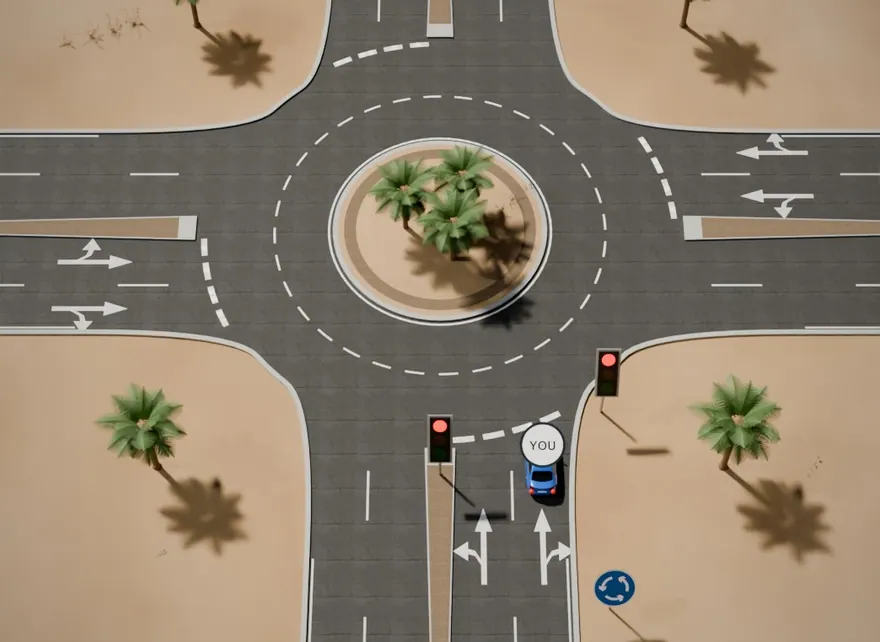
33You arrive at a large roundabout that has traffic lights at every entry. Your light is red, but the roundabout looks completely empty. What should you do?

Explanation

Where traffic lights control a roundabout, the signals decide priority and a red light means stop. The ordinary give-way-to-the-left rule only takes over if the signals are not working.

RTA Light Motor Vehicle Handbook (rta.ae PDF), Part 5 — Traffic Control at Intersections (traffic signals)

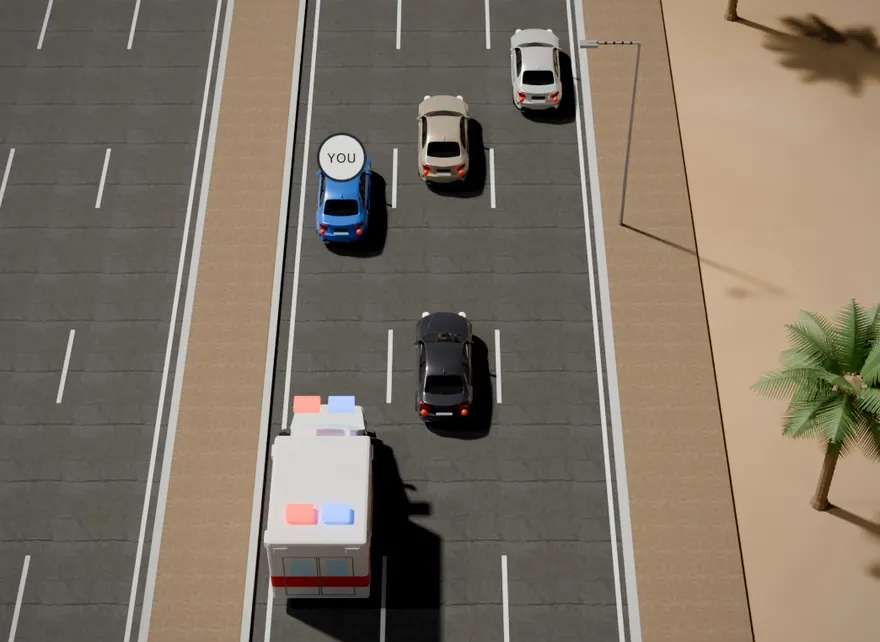
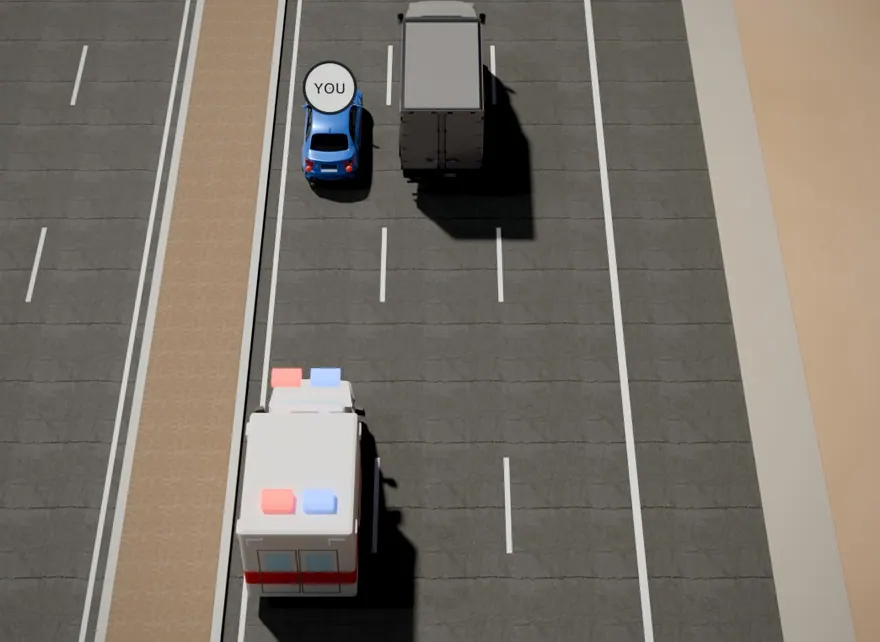
34You are halfway through overtaking a long truck in the left lane of a freeway when an ambulance with siren and lights appears behind you. What should you do?

Explanation

You must give way to the ambulance as quickly and safely as possible. Braking alongside a truck keeps the lane blocked, and cutting in close in front of a truck is dangerous; finish the pass, then pull right.

RTA Light Motor Vehicle Handbook, Part 4; RTA Light Motor Vehicle Handbook (3rd ed.), Part 5 — Overtaking Trucks

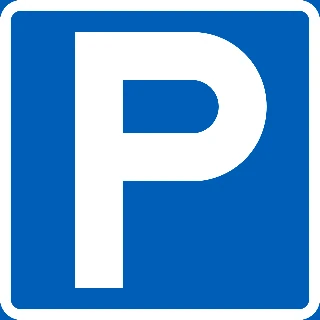
35This sign stands beside a row of marked bays and has no plate underneath it. What does it tell you?

Explanation

The blue square with a white P means parking is allowed. Any conditions, such as hours, a zone code or payment, would be shown on a plate beneath it; with no plate there are none.

RTA Light Motor Vehicle Handbook, Part 5