Crossroads
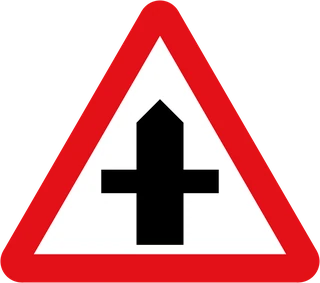
A crossroads is ahead. The thick line shows the road with priority. Watch for vehicles emerging from either side and be ready to slow down.
Memory trick Thick line = priority road; thin lines = side roads.
75 signs
A crossroads is ahead. The thick line shows the road with priority. Watch for vehicles emerging from either side and be ready to slow down.
Memory trick Thick line = priority road; thin lines = side roads.
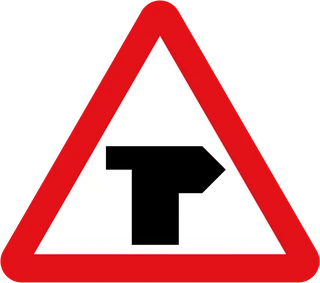
The main road ahead bends to the left at a T-junction and a side road joins from the right. You have priority over traffic from that side road, but stay alert for drivers who may not give way.
Memory trick You are the thick line; the thin branch has to wait.
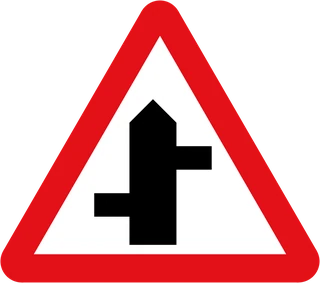
Two side roads join the main road a short distance apart on opposite sides. Vehicles may cross from one to the other in two moves, so expect traffic to pull out and turn in quick succession.
Memory trick Branches that don't line up — a zig-zag crossroads.
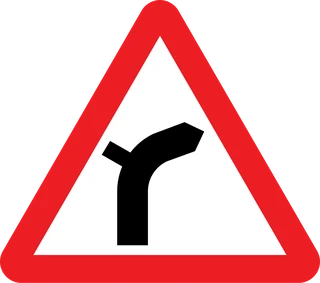
A side road joins on a bend where visibility is poor. Slow down before the bend and watch for emerging traffic.
Memory trick A bend with a branch sprouting from it.
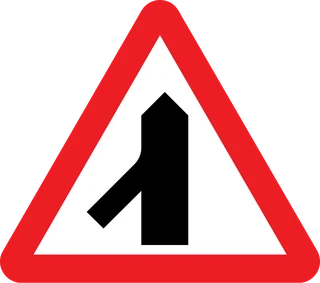
Vehicles will join your road from the left and merge with your lane. Adjust your speed to let them in and check your mirrors.
Memory trick A thin line sliding into the thick one — make room.
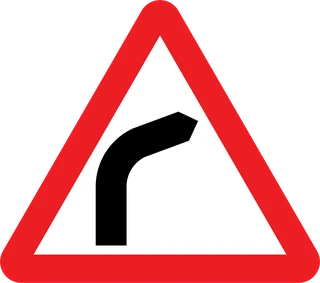
A sharp bend to the right is ahead. Slow down before the bend, not in it, and keep to the left of your lane for the best view.
Memory trick The arrow bends the way the road does.
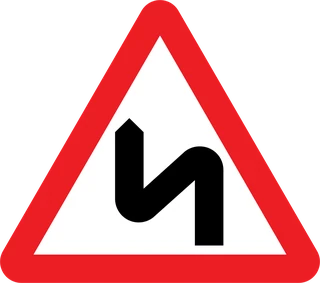
A series of bends starts with a left-hand bend. A plate may show the distance over which the bends continue. Reduce speed and avoid overtaking.
Memory trick S-shaped arrow: follow it from the bottom to see which bend comes first.
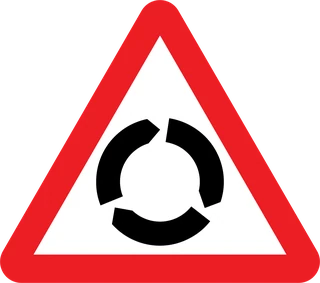
A roundabout is ahead. Decide your exit early, get in the correct lane, and give way to traffic already on the roundabout approaching from your right.
Memory trick Three arrows in a circle, in a red triangle — a warning, not the mini-roundabout order.
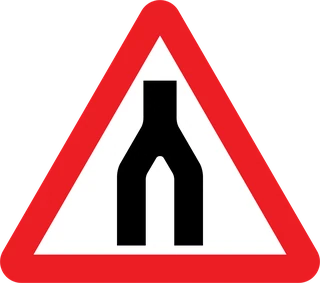
The central reservation ends and the road becomes a two-way single carriageway. Expect oncoming traffic and a lower speed limit.
Memory trick Two lanes funnelling into one line — the divider disappears.
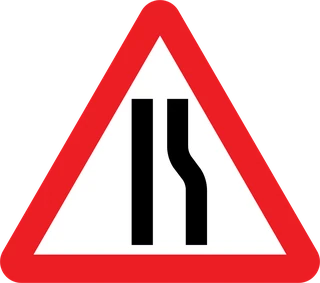
The road gets narrower on the right-hand side. Oncoming traffic may move towards the centre, so give it room.
Memory trick The kerb line that bends inwards is the side that narrows.
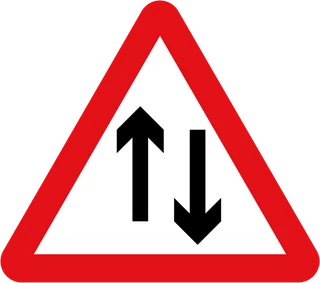
You are leaving a one-way or dual-carriageway section and oncoming traffic will now share the road. Keep left.
Memory trick Up and down arrows side by side — traffic now comes towards you.
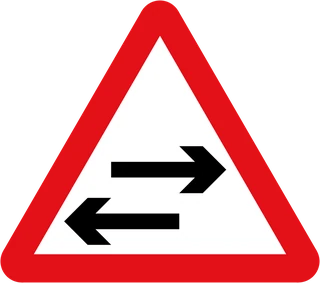
The one-way road you are on is crossed by a two-way road ahead. Look both ways at the junction even though your own road is one-way.
Memory trick A horizontal double arrow across your vertical arrow.
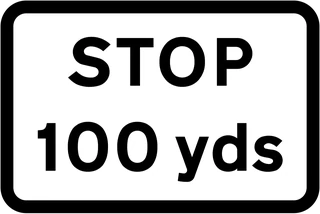
A STOP sign and line are the stated distance ahead. Used where the junction is hidden. Begin slowing now so you can stop at the line.
Memory trick A triangle with 'STOP' and a distance — the octagon is round the corner.
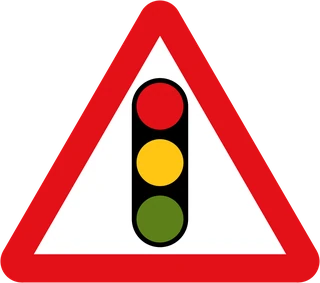
Traffic lights are ahead, possibly hidden by a bend or hill. Be ready to stop if they change to amber or red.
Memory trick Red, amber and green dots in a triangle.
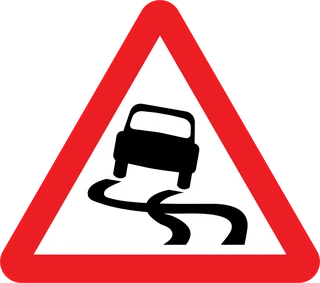
The surface ahead may be slippery, for example when wet, muddy or icy. Slow down, avoid harsh braking and steering, and increase your following distance.
Memory trick A car with skid marks behind it.
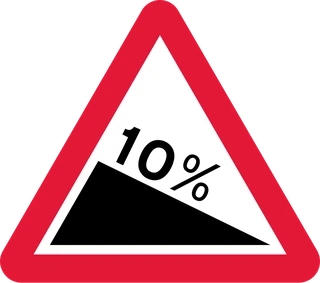
A steep descent is ahead; the gradient is shown as a percentage (10% means 1 in 10). Select a lower gear before the hill so the engine helps to control your speed.
Memory trick The slope drops to the right, like reading left to right downhill.
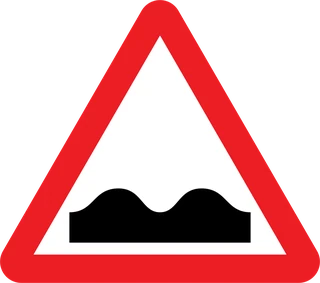
The road surface is bumpy or has potholes. Slow down to protect your tyres and suspension and to keep control.
Memory trick Two bumps in a row — not the single hump bridge.
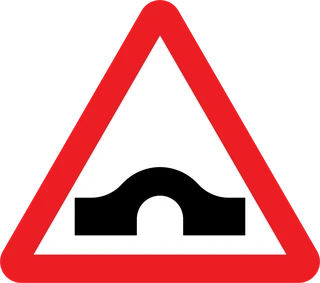
A steeply arched bridge is ahead with limited view over the top. Slow down and expect oncoming traffic or a hidden obstruction just beyond the crest.
Memory trick One big hump = bridge; two small ones = uneven road.
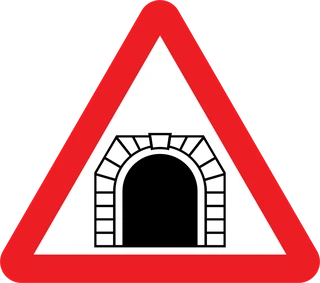
A tunnel is ahead. Switch on dipped headlights, remove sunglasses, keep a safe distance and follow any lane or speed signals inside.
Memory trick A black archway — lights on before you go in.
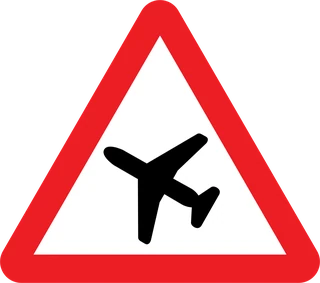
You are near an airfield; aircraft may pass very low or make sudden loud noise. Do not be distracted — keep your attention on the road.
Memory trick Aeroplane silhouette: eyes on the road, not the sky.
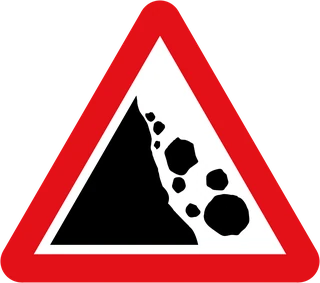
Rocks may fall onto the road or already be lying on it, typically beside cliffs and cuttings. Watch the road surface and avoid stopping under the slope.
Memory trick Rocks tumbling down a slope.
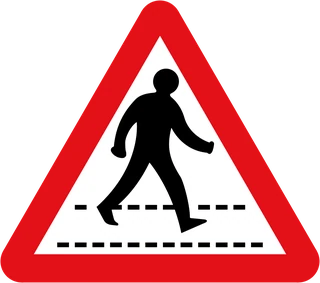
A pedestrian crossing is ahead. Look for people waiting to cross and be ready to stop; you must give way once someone has stepped onto the crossing.
Memory trick A person on stripes — look for the flashing yellow beacons.
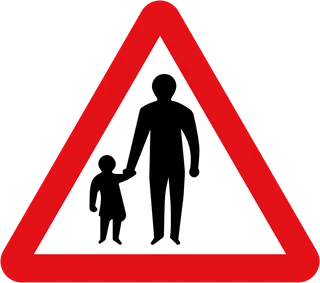
There is no footway, so people may be walking in the road, possibly facing you. Slow down and give them at least 2 metres as you pass.
Memory trick A walker but no stripes — they're in the road itself.
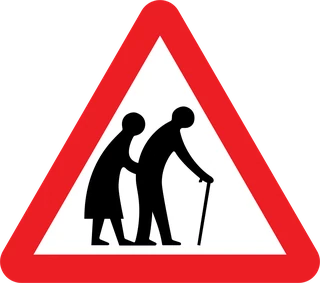
Elderly, frail, blind or disabled people often cross here, for example near a care home or hospital. They may be slow to cross — be patient and ready to stop.
Memory trick Two figures with a stick — give them time.
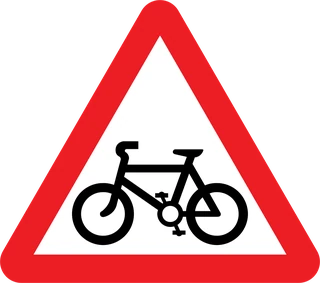
Cyclists may join or cross the road ahead. A red triangle means it is a warning about cyclists, not a route reserved for them.
Memory trick Bike in a red triangle = look out for cyclists; bike on a blue disc = cycle route.
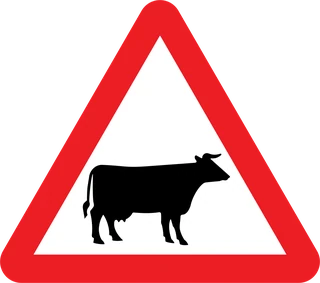
Cattle may be on or crossing the road, especially near farms. Slow down, be ready to stop and do not sound your horn near animals.
Memory trick A cow in a triangle — farm traffic ahead.
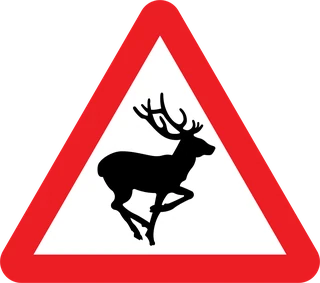
Deer or other wild animals may run across the road, particularly at dawn and dusk. Slow down and be ready to brake; if one crosses, more may follow.
Memory trick A leaping deer.
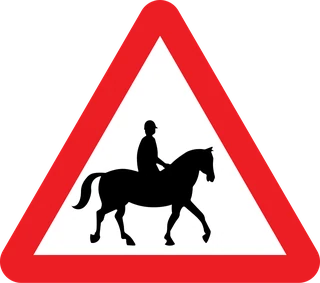
Ridden or led horses use this road. Pass wide and slow — at most 10 mph and at least 2 metres away — and do not rev your engine or sound your horn.
Memory trick Horse with a rider: slow to 10 mph, 2 metres of space.
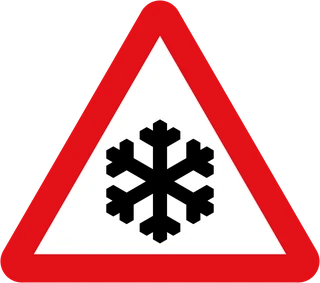
The road is prone to ice or packed snow, for example on exposed or shaded stretches. Slow down, brake and steer gently and leave up to ten times the normal stopping distance.
Memory trick A snowflake: stopping distances can be 10× longer.
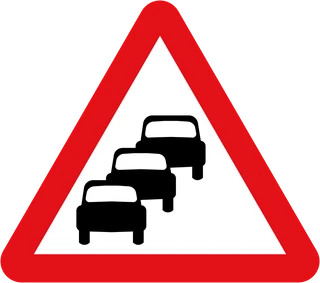
Stationary or slow queues are likely ahead, for example before a junction or roadworks. Reduce speed early and watch your mirrors for traffic behind.
Memory trick A row of cars nose to tail.
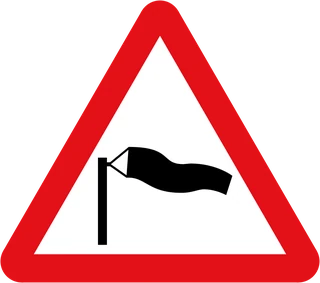
Strong crosswinds are likely, such as on exposed bridges and open stretches. Hold the steering firmly, allow extra room when passing cyclists, motorcyclists and high-sided vehicles.
Memory trick A windsock blowing sideways.
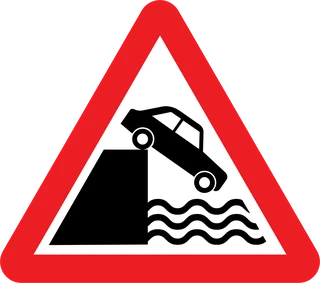
The road runs beside a quay, canal or river with no barrier. Take extra care, especially when reversing or in fog and darkness.
Memory trick A car tipping towards the water.
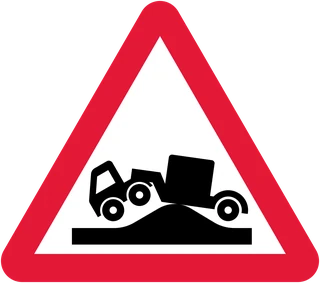
Long or low vehicles could become stuck on a hump, often at a level crossing or hump bridge. Drivers of such vehicles should use another route or seek advice.
Memory trick A lorry balanced on a hump like a see-saw.
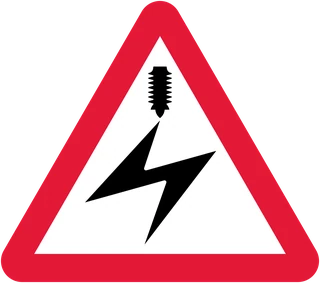
Live electric cables cross above the road, typically at a railway or tramway. A plate shows the safe height; high vehicles must not touch the cables.
Memory trick A lightning bolt over the road — check your height.
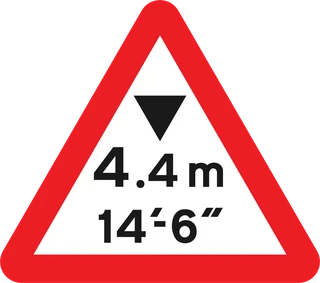
The arch bridge ahead has limited headroom; the sign shows the safe headroom, in feet and inches and metres, over the width indicated. Road markings guide high vehicles through the highest part of the arch, so they may need to use the centre of the road.
Memory trick An arch with a measurement — low bridge, check your height.

Black and white chevrons mark a sharp change of direction, pointing the way the road goes. Slow right down before them.
Memory trick Chevrons point where the road goes — follow the arrows.
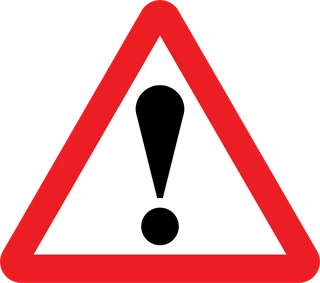
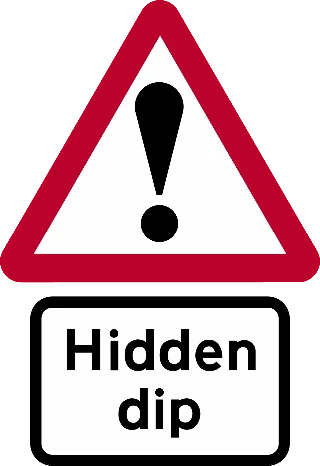
An exclamation mark warns of a hazard not covered by a specific sign; a plate underneath explains it, for example 'hidden dip' or 'road liable to flooding'.
Memory trick Exclamation mark: read the plate for the actual danger.
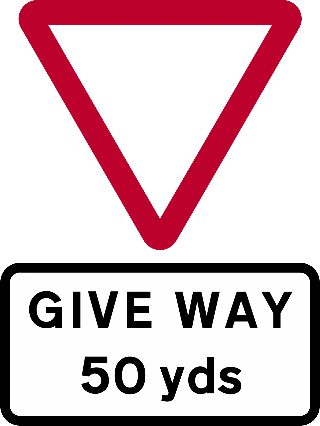
A 'give way' line is ahead at the distance shown on the plate. Be ready to slow down and give way.
Memory trick Upside-down triangle on a post: the line is coming up.
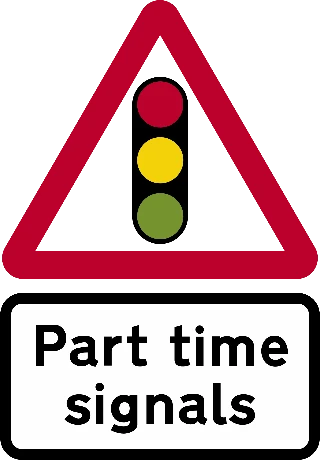
Traffic signals ahead that operate only at certain times.
Memory trick Part-time plate: the lights might be off when you arrive, but do not count on it.
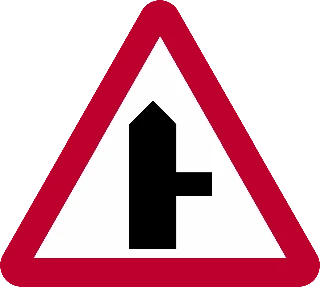
A side road joins from one side ahead. The broader line shows the road with priority.
Memory trick One thin stub off a thick line: traffic may pull out from the stub.
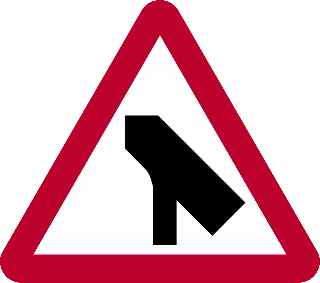
Traffic merges onto the main carriageway ahead. The broader line is the through route.
Memory trick The stub leans into the thick line: someone is about to join you.
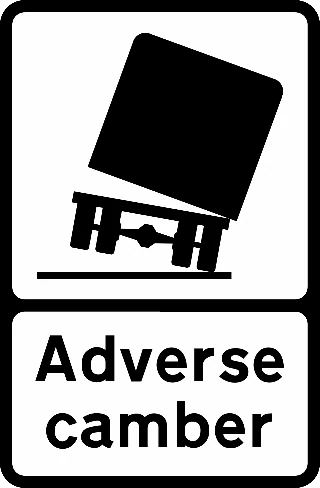
Risk of lorries overturning on a bend to the left (right if the symbol is reversed).
Memory trick Tipping lorry on the plate: slow down early if you are driving something tall.
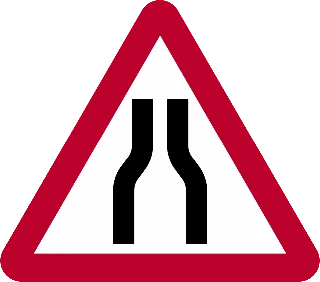
The road narrows on both sides ahead.
Memory trick Both lines pinch in: both sides shrink.

Marks the near-side edge of the carriageway or an obstruction near that edge. White markers are used on the off-side edge, and amber ones on the off-side edge of a dual carriageway.
Memory trick Red on your left, as with red studs.
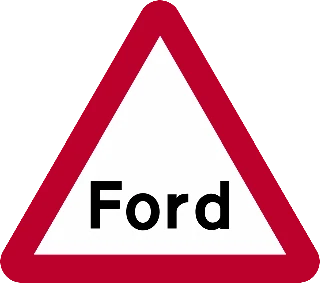
Worded warning of a ford. 'Ford' may be varied to 'Flood', 'Gate', 'Gates' or 'No smoking'.
Memory trick A triangle with a word instead of a symbol: read the word, the warning is the same.
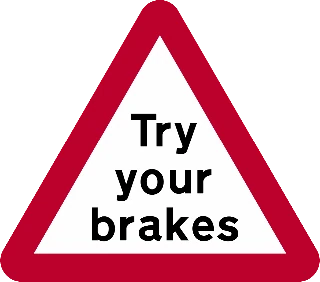
Try your brakes after crossing a ford or before descending a steep hill.
Memory trick Wet brakes are weak brakes: test them while it is still safe.
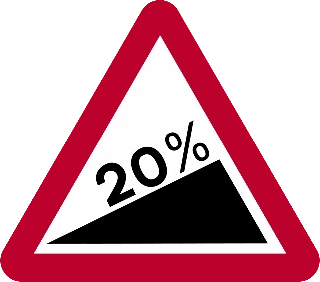
Steep hill upwards. 20% is equivalent to 1:5.
Memory trick Wedge rising to the right with the number on top: uphill. Change down in good time.
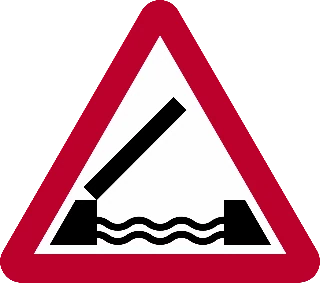
Opening or swing bridge ahead.
Memory trick Raised deck over waves: the road itself can lift out of the way.
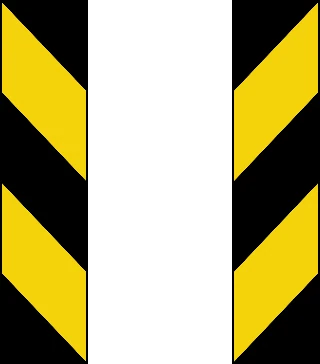
Marks the end of a bridge parapet, an abutment wall or a tunnel mouth.
Memory trick Black and yellow bands: solid thing at the road edge.
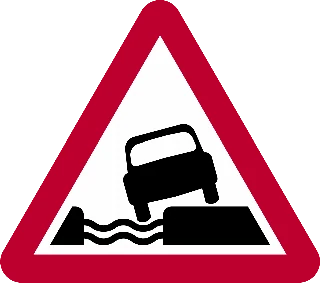
A water course runs alongside the road.
Memory trick Car and waves beside the road: water next to you, not at the end of the road.
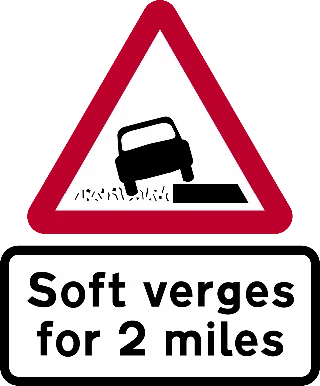
Soft verges for the distance shown.
Memory trick Keep your wheels on the tarmac: the edge will not hold you.
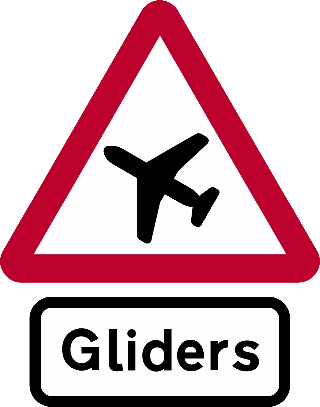
Gliders likely.
Memory trick Quiet aircraft: you will not hear them coming.
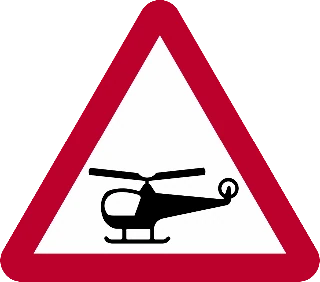
Low-flying helicopters or sudden helicopter noise.
Memory trick Sudden noise overhead: keep calm and keep your line.
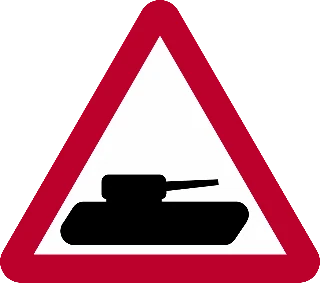
Slow-moving military vehicles likely to be in or crossing the road.
Memory trick Tank in the triangle: expect big and slow.
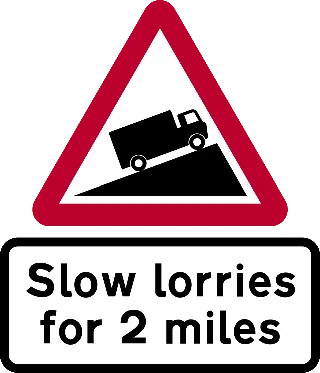
Slow-moving vehicles for the distance shown.
Memory trick Lorry climbing a wedge: plan your overtake with care, or do not.
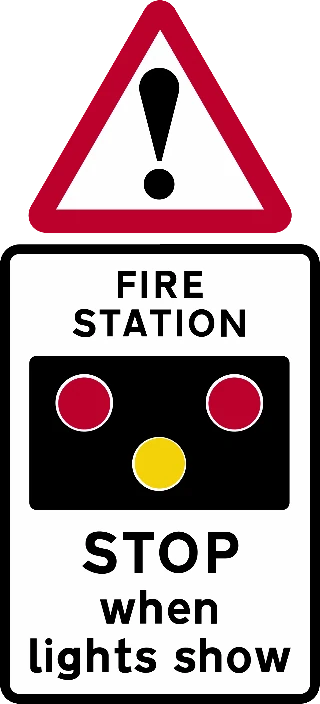
Warning of signals. 'FIRE' may be varied to 'AMBULANCE' or 'POLICE'. Stop when the lights show.
Memory trick Emergency exit ahead: when the lights flash, the road belongs to them.
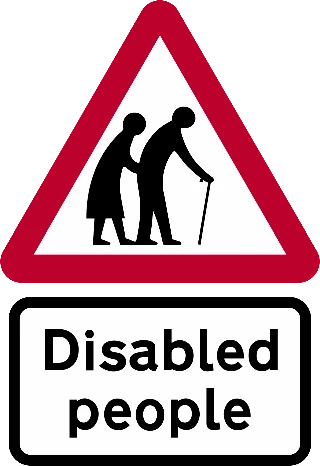
Disabled pedestrians. 'Disabled' may be varied to 'Blind'.
Memory trick The plate tells you why the figures are moving slowly.
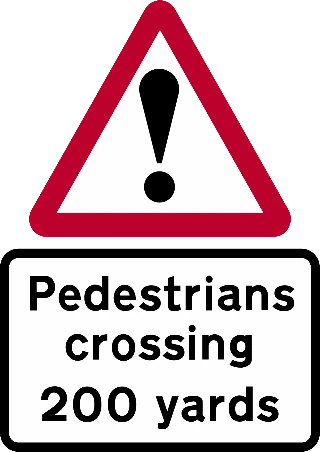
Pedestrians are likely to be crossing a high-speed road where there is no formal crossing point.
Memory trick No crossing built, but people still cross. High speed means long stopping distances.
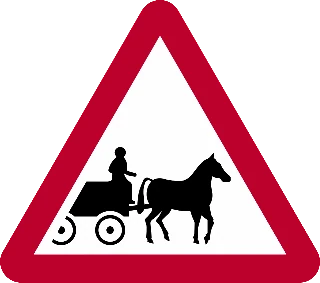
Horse-drawn vehicles are likely to be in the road.
Memory trick Carriage in a triangle: pass slowly and wide, do not rev.
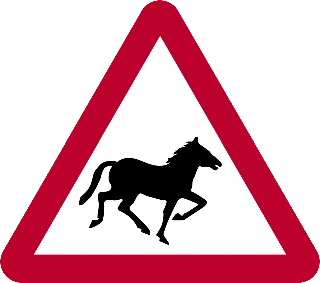
Wild horses or ponies.
Memory trick No rider means nobody controlling it: expect it to step out.
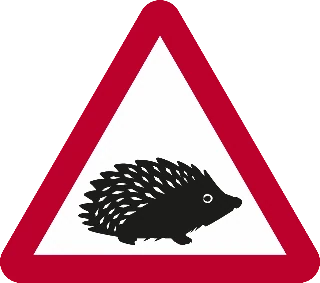
Small wild animals.
Memory trick Hedgehog size, not deer size: small, low and hard to see at night.
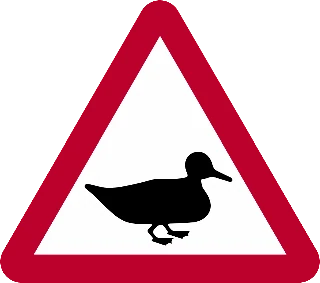
Wild fowl.
Memory trick Duck in the triangle: birds on foot may cross.
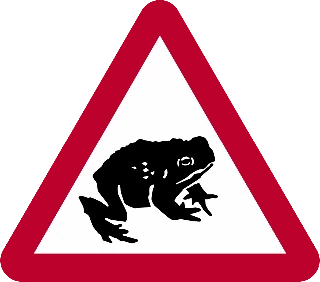
Migratory toad crossing.
Memory trick Toads on the march across the road.
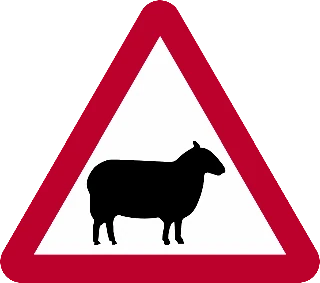
Sheep.
Memory trick Woolly outline: a flock may fill the road around the next bend.
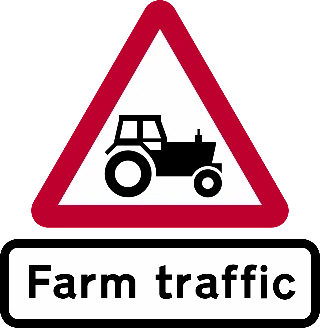
Agricultural vehicles.
Memory trick Tractor triangle: slow, wide and maybe muddy.
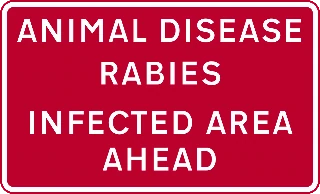
Area infected by animal disease.
Memory trick Red panel with words: an animal disease is in the area ahead.
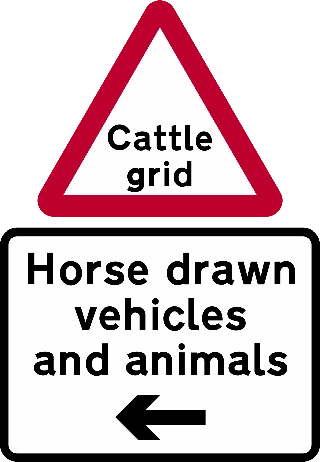
Cattle grid with an indication of a bypass for horse-drawn vehicles and animals.
Memory trick Metal bars across the road: horses and carts use the bypass.
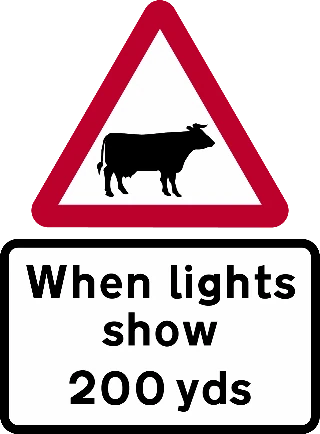
Supervised cattle crossing ahead, at the distance shown, when the lights show.
Memory trick Cow and lights: the plate tells you how far.
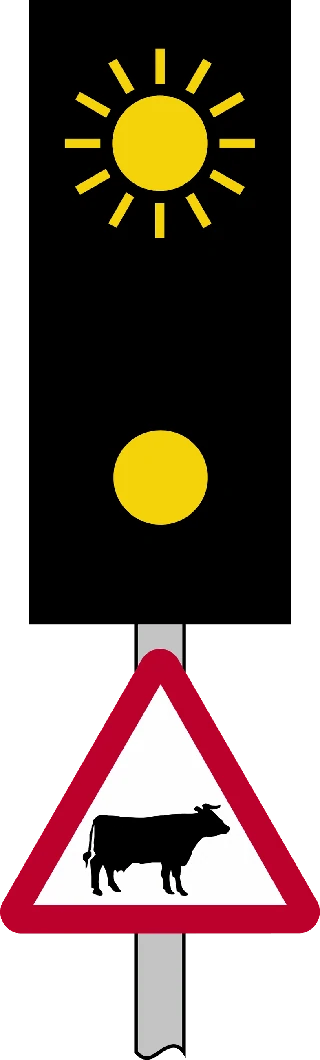
Supervised cattle crossing. The light flashes when cattle may be crossing.
Memory trick Same cow, now at the crossing: slow down when the light flashes.
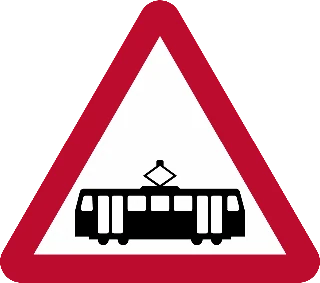
Warning of trams crossing the road ahead.
Memory trick Triangle warns, tram in it: they will not swerve.
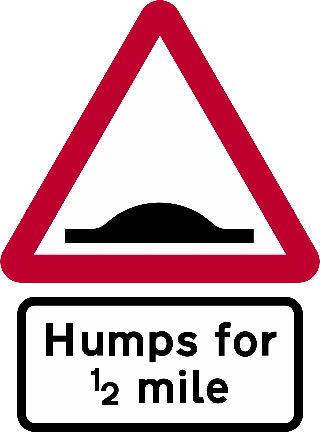
Road humps for the distance shown. May be varied to 'Hump' with the distance omitted.
Memory trick Hump in a triangle, plate says how far they carry on.
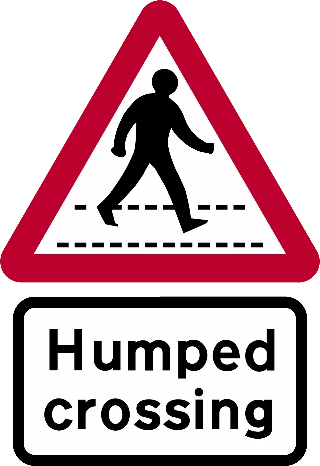
Zebra or parallel crossing on a road hump.
Memory trick Crossing plus hump, and one warning covers both.
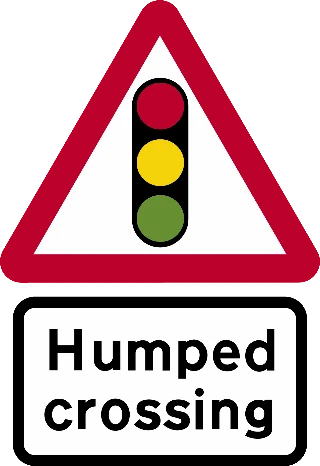
Signal-controlled pedestrian crossing on a road hump.
Memory trick Traffic light in the triangle and the same plate.
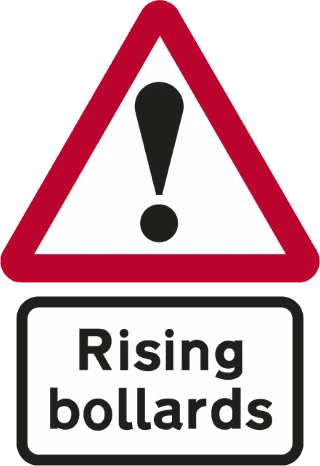
In some town and city centres, certain streets may be closed for part of the day. Enforcement may be by the use of rising bollards, and this sign warns of them.
Memory trick Follow the vehicle in front and a bollard may come up under you.